The Gift of Chess

Notice to commercial publishers seeking use of images from this collection of chess-related archive blogs. For use of the many large color restorations, two conditions must be met: 1) It is YOUR responsibility to obtain written permissions for use from the current holders of rights over the original b/w photo. Then, 2) make a tax-deductible donation to The Gift of Chess in honor of Robert J. Fischer-Newspaper Archives. A donation in the amount of $250 USD or greater is requested for images above 2000 pixels and other special request items. For small images, such as for fair use on personal blogs, all credits must remain intact and a donation is still requested but negotiable. Please direct any photographs for restoration and special request (for best results, scanned and submitted at their highest possible resolution), including any additional questions to S. Mooney, at bobbynewspaperblogs•gmail. As highlighted in the ABC News feature, chess has numerous benefits for individuals, including enhancing critical thinking and problem-solving skills, improving concentration and memory, and promoting social interaction and community building. Initiatives like The Gift of Chess have the potential to bring these benefits to a wider audience, particularly in areas where access to educational and recreational resources is limited.

Best of Chess Fischer Newspaper Archives
• Robert J. Fischer, 1955 ➦
• Robert J. Fischer, 1956 ➦
• Robert J. Fischer, 1957 ➦
• Robert J. Fischer, 1958 ➦
• Robert J. Fischer, 1959 ➦
• Robert J. Fischer, 1960 ➦
• Robert J. Fischer, 1961 ➦
• Robert J. Fischer, 1962 ➦
• Robert J. Fischer, 1963 ➦
• Robert J. Fischer, 1964 ➦
• Robert J. Fischer, 1965 ➦
• Robert J. Fischer, 1966 ➦
• Robert J. Fischer, 1967 ➦
• Robert J. Fischer, 1968 ➦
• Robert J. Fischer, 1969 ➦
• Robert J. Fischer, 1970 ➦
• Robert J. Fischer, 1971 ➦
• Robert J. Fischer, 1972 ➦
• Robert J. Fischer, 1973 ➦
• Robert J. Fischer, 1974 ➦
• Robert J. Fischer, 1975 ➦
• Robert J. Fischer, 1976 ➦
• Robert J. Fischer, 1977 ➦
• Robert J. Fischer, 1978 ➦
• Robert J. Fischer, 1979 ➦
• Robert J. Fischer, 1980 ➦
• Robert J. Fischer, 1981 ➦
• Robert J. Fischer, 1982 ➦
• Robert J. Fischer, 1983 ➦
• Robert J. Fischer, 1984 ➦
• Robert J. Fischer, 1985 ➦
• Robert J. Fischer, 1986 ➦
• Robert J. Fischer, 1987 ➦
• Robert J. Fischer, 1988 ➦
• Robert J. Fischer, 1989 ➦
• Robert J. Fischer, 1990 ➦
• Robert J. Fischer, 1991 ➦
• Robert J. Fischer, 1992 ➦
• Robert J. Fischer, 1993 ➦
• Robert J. Fischer, 1994 ➦
• Robert J. Fischer, 1995 ➦
• Robert J. Fischer, 1996 ➦
• Robert J. Fischer, 1997 ➦
• Robert J. Fischer, 1998 ➦
• Robert J. Fischer, 1999 ➦
• Robert J. Fischer, 2000 ➦
• Robert J. Fischer, 2001 ➦
• Robert J. Fischer, 2002 ➦
• Robert J. Fischer, 2003 ➦
• Robert J. Fischer, 2004 ➦
• Robert J. Fischer, 2005 ➦
• Robert J. Fischer, 2006 ➦
• Robert J. Fischer, 2007 ➦
• Robert J. Fischer, 2008 ➦
Chess Columns
Chessgames.com: Newspaper Chess Games Archive Chess.com: Newspaper Chess Games Archive Facebook: Bobby Fischer History Youtube: Newspaper Chess Games Archive My Life Notes lichess.org: Analyze Chess Game lichess.org: Board Editor Chess Notation Converter Chess.com: Chess Board Analysis Notes
Showing posts with label Samuel Reshevsky. Show all posts

Tel Aviv Chess Olympics

Back to 1964 News Articles

The Los Angeles Times Los Angeles, California Sunday, August 16, 1964 - Page 87

Tel Aviv Chess Olympics
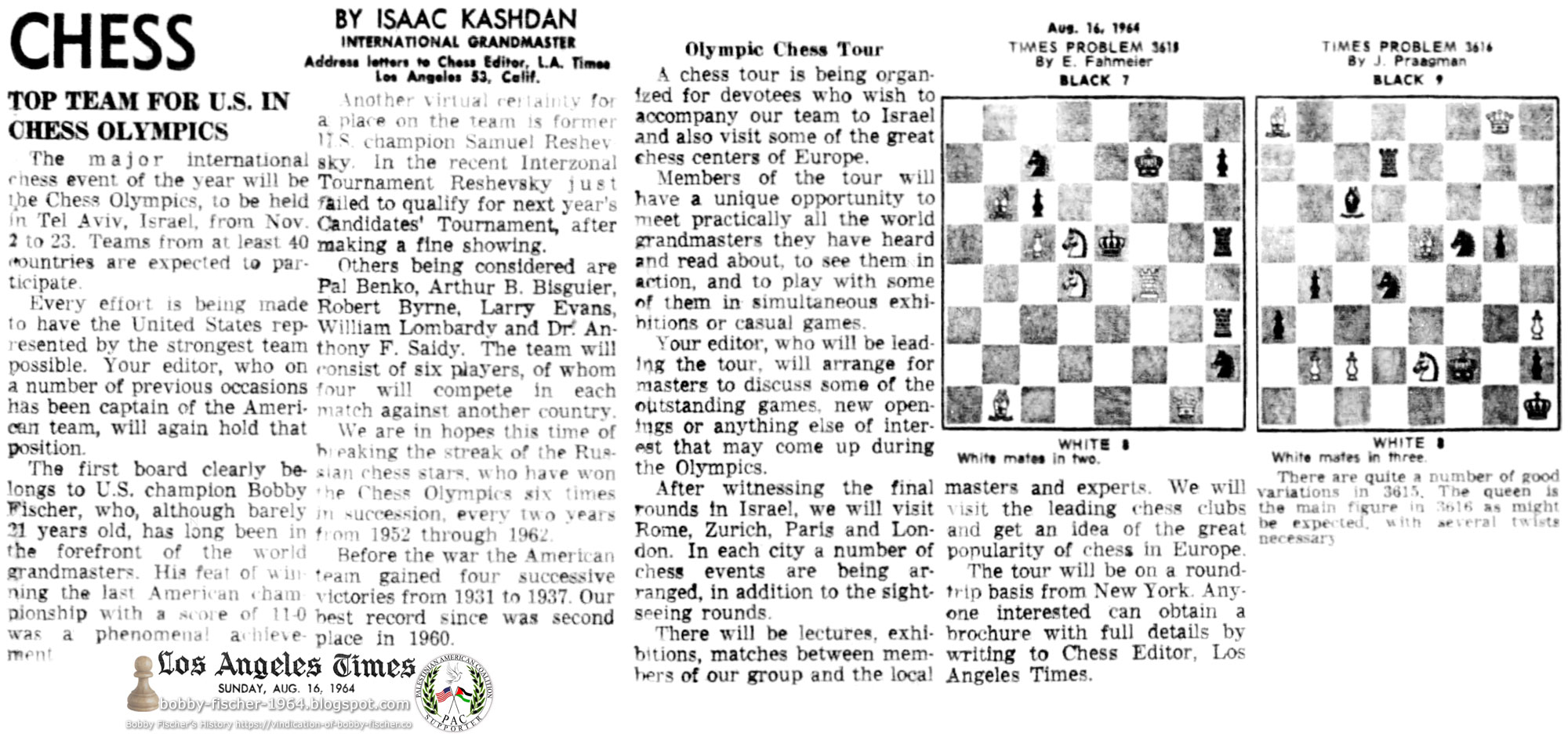
The major international chess event of the year will be the Chess Olympics, to be held in Tel Aviv, Israel, from Nov. 2 to 23. Teams from at least 40 countries are expected to participate.
Every effort is being made to have the United States represented by the strongest team possible. Your editor, who on a number of previous occasions has been captain of the American team, will again hold that position.
The first board clearly belongs to U.S. champion Bobby Fischer, who, although barely 21 years old, has long been in the forefront of the world grandmasters. His feat of winning the last American championship with a score of 11-0 was a phenomenal achievement.
Another virtual certainty for a place on the team is former U.S. champion Samuel Reshevsky. In the recent Interzonal Tournament Reshevsky just failed to qualify for next year's candidates' Tournament, after making a fine showing.
Others being considered are Pal Benko, Arthur B. Bisguier, Robert Byrne, Larry Evans, William Lombardy and Dr. Anthony F. Saidy. The team will consist of six players, of whom will compete in each match against another country.
We are in hopes this time of breaking the streak of the Russian chess stars, who have won the Chess Olympics six times in succession, every two years from 1952 through 1962.
Before the war the American team gained four successive victories from 1931 to 1937. Our best record since was second place in 1960.

Olympic Chess Tour
A chess tour is being organized for devotees who wish to accompany our team to Israel and also visit some of the great chess centers of Europe.
Members of the tour will have a unique opportunity to meet practically all the world grandmasters they have heard and read about, to see them in action, and to play with some of them in simultaneous exhibitions or casual games.
Your editor, who will be leading the tour, will arrange for masters to discuss some of the outstanding games, new openings or anything else of interest that may come up during the Olympics.
After witnessing the final rounds in Israel, we will visit Rome, Zurich, Paris and London. In each city a number of chess events are being arranged, in addition to the sight-seeing rounds.
There will be lectures, exhibitions, matches between members of our group and the local masters and experts. We will the leading chess clubs and get an idea of the great popularity of chess in Europe.
The tour will be on a round-trip basis from New York. Anyone interested can obtain a brochure with full details by writing to Chess Editor, Los Angeles Times.
Tel Aviv Chess Olympics

The Helpless Chess Nut

Back to 1964 News Articles

The Emporia Gazette Emporia, Kansas Friday, December 11, 1964 - Page 2

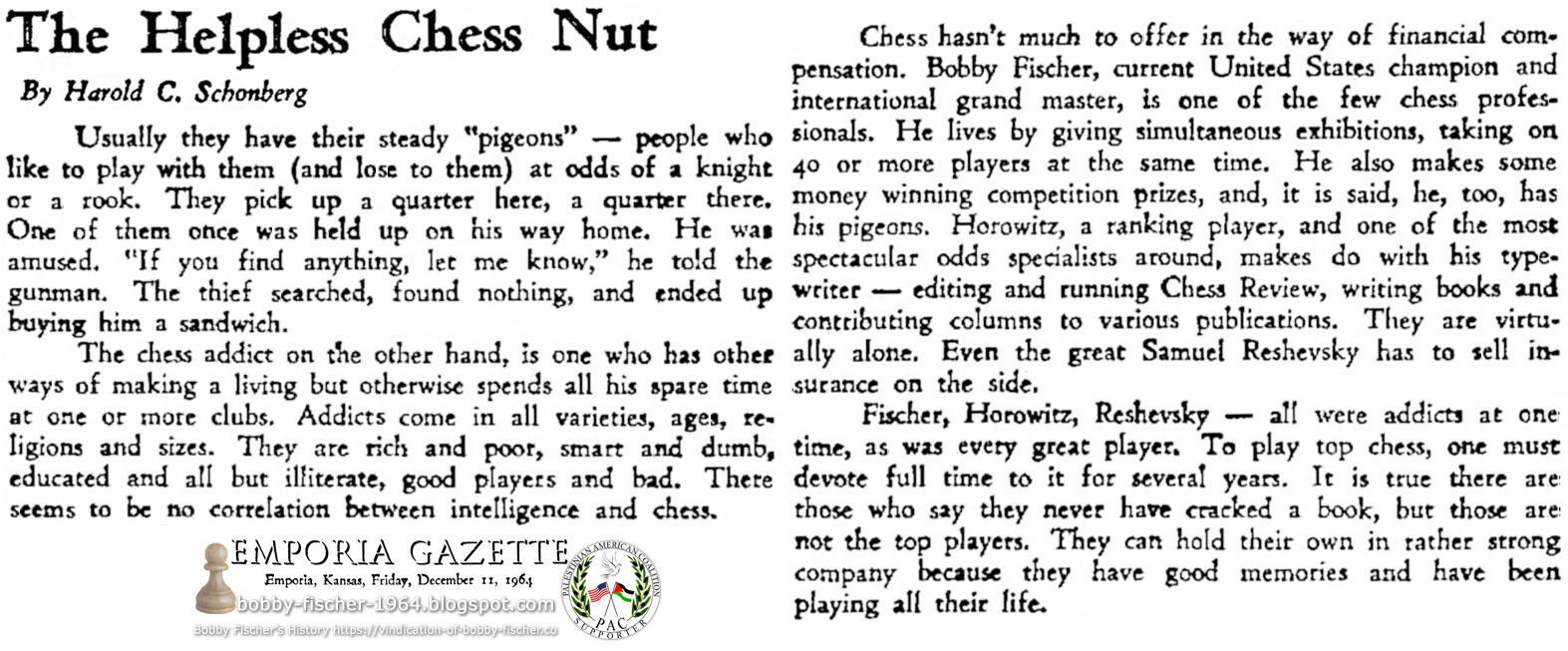
The Helpless Chess Nut
“…Chess hasn't much to offer in the way of financial compensation. Bobby Fischer, current United States champion and international grand master, is one of the few chess professionals. He lives by giving simultaneous exhibitions, taking on 40 or more players at the same time. He also makes some money winning competition prizes, and, it is said, he, too, has his pigeons…
Fischer, Horowitz, Reshevsky — all were addicts at one time, as was every great player. To play top chess, one must devote full time to it for several years.…

The Helpless Chess Nut

Divinsky's Chess Charivari

Back to 1964 News Articles

The Province Vancouver, British Columbia, Canada Saturday, January 18, 1964 - Page 66

Divinsky's Chess Charivari
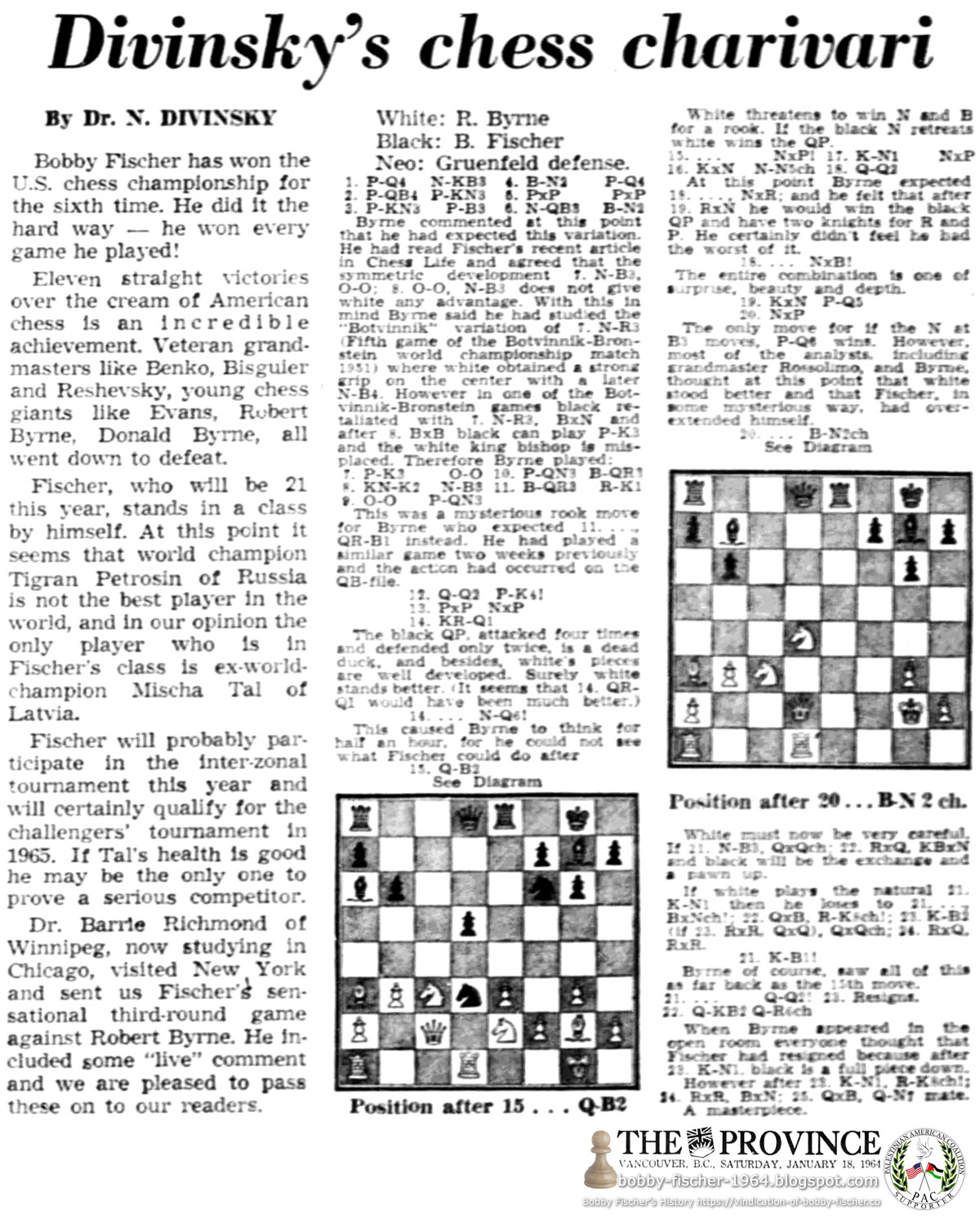
By Dr. N. Divinsky

Bobby Fischer has won the U.S. chess championship for the sixth time. He did it the hard way - he won every game he played!
Eleven straight victories over the cream of American chess is an incredible achievement. Veteran grandmasters like Benko, Bisguier and Reshevsky, young chess giants like Evans, Robert Byrne, Donald Byrne, all went down to defeat.
Fischer, who will be 21 this year, stands in a class by himself. At this point it seems that world champion Tigran Petrosian of Russia is not the best player in the world, and in our opinion the only player who is in Fischer's class is ex-world-champion Mischa Tal of Latvia.
Fischer will probably participate in the inter-zonal tournament this year and will certainly qualify for the challengers' tournament in 1965. If Tal's health is good he may be the only one to prove a serious competitor.
Dr. Barrie Richmond of Winnipeg, now studying in Chicago, visited New York and sent us Fischer's sensational third-round game against Robert Byrne. He included some “live” comment and we are pleased to pass these on to our readers.

White: R. Byrne
Black: B. Fischer
Neo: Gruenfeld defense
1. P-Q4 N-KB3
2. P-QB4 P-KN3
3. P-KN3 P-B3
4. B-N2 P-Q4
5. PxP PxP
6. N-QB3 B-N2
Byrne commented at this point that be had expected this variation. He had read Fischer's recent article in Chess Life and agreed that the symmetric development
7. N-B3, O-O;
8. O-O, N-B3 does not give white any advantage. With this in mind Byrne said be had studied the “Botvinnik” variation of 7. N-R3 (Fifth game of the Botvinnik-Bronstein world championship match; 1951) where white obtained a strong grip on the center with a later N-B4. However in one of the Botvinnik-Bronstein games black retaliated with 7. N-R3, BxN and after 8. BxB black can play P-K3, and the white king bishop is misplaced. Therefore Byrne played:
7. P-K3 O-O
8. KN-K2 N-B3
9. O-O P-QN3
10. P-QN3 B-QR3
11. B-QR3 R-K1
This was a mysterious rook move for Byrne who expected 11…QR-B1 instead. He had played a similar game two weeks previously and the action had occurred on the QB-file.
12. Q-Q2 P-K4!
13. PxP NxP
14. KR-Q1
The black QP, attacked four times and defended only twice, is a dead duck, and besides, white's pieces are well developed. Surely white stands better. (It seems that 14. QR-Q1 would have been much better.)
14… N-Q6!
This caused Byrne to think for half an hour, for he could not see what Fischer could do after
15. Q-B2
See Diagram.
Position after 15…Q-B2

White threatens to win N and B for a rook. If the black N retreats white wins the QP.
15. … NxP!
16. KxN N-N5ch
17. K-N1 NxP
18. Q-Q2
At this point Byrne expected
18 … NxR; and he felt that after
19. RxN he would win the black QP and have two knights for R and P. He certainly didn't feel he had the worst of it.
18. … NxB!
The entire combination is one of surprise, beauty and depth.
19. KxN P-Q5
20. NxP
The only move for it the N at B3 moves, P-Q6 wins. However, most of the analysts, including grandmaster Rossolimo, and Byrne, thought at this point that white stood better and that Fischer, in some mysterious way, had overextended himself.
20 … B-N2ch
See Diagram.
Position after 20…B-N2 ch.

White must now be very careful. If 21. N-B3, QxQch; 22. RxQ, KBxN and black will be the exchange and a pawn up.
If white plays the natural 21. K-N1 then he loses to 21 … BxNch!; 22. QxB, R-K8ch!; 23. K-B2 (if 23. RxR, QxQ), QxQch; 24. RxQ, RxR.
21. K-B1!
Byrne of course, saw all of this as far back as the 15th move.
21 … Q-Q2!
22. Q-KB2 Q-R6ch
23. Resigns.
When Byrne appeared in the open room everyone thought that Fischer had resigned because after 23. K-N1, black is a full piece down.
However after 23. K-N1, R-K8ch1; 24. RxR, BxN; 25. QxB, QN7 mate.
A masterpiece.

Divinsky's Chess Charivari

Bobby Fischer Proves His Elements on Current Exhibition Tour

Back to 1964 News Articles

Daily Press Newport News, Virginia Sunday, May 17, 1964 - Page 94

Bobby Fischer Proves His Elements on Current Exhibition Tour
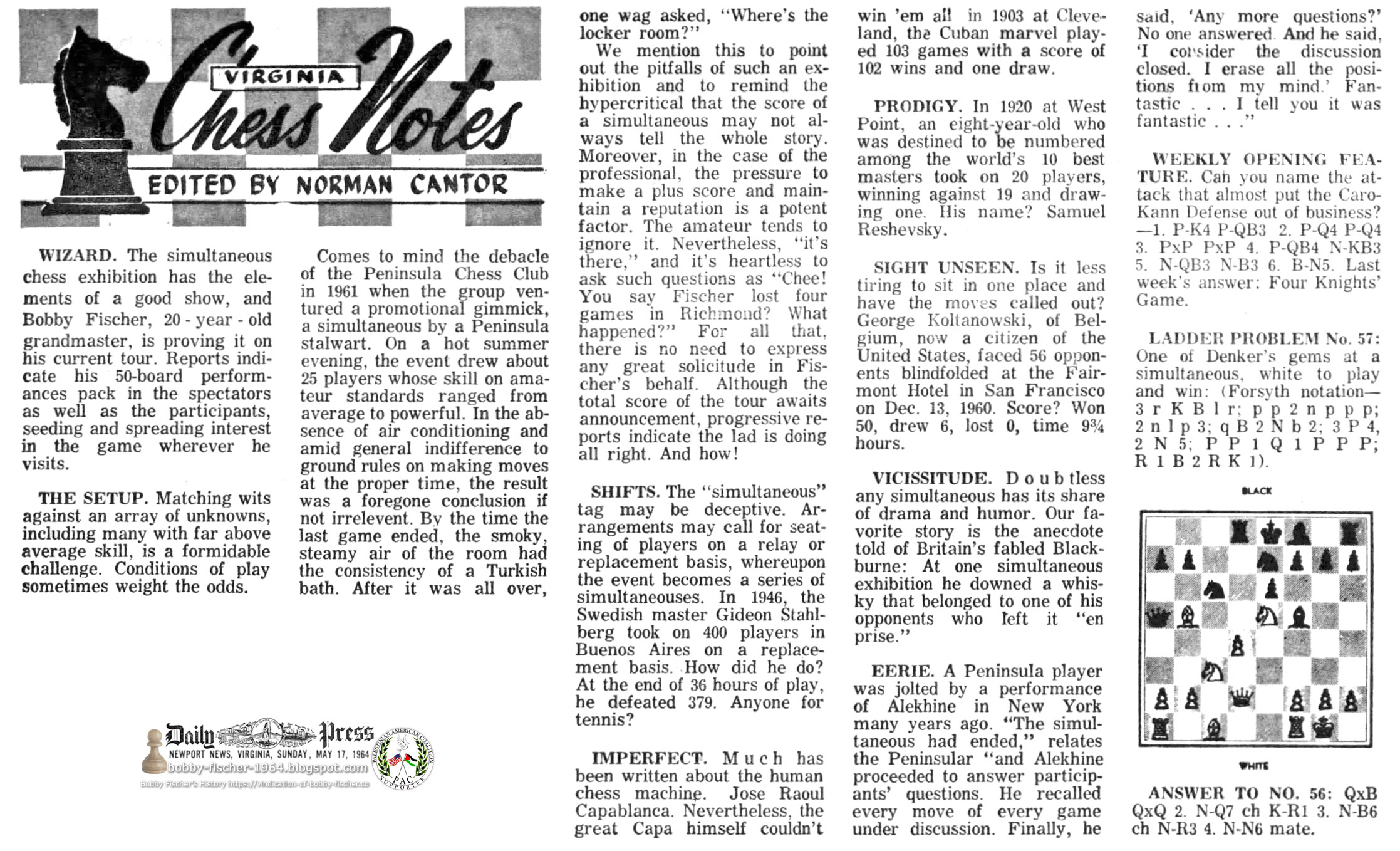
WIZARD. The simultaneous chess exhibition has the elements of a good show, and Bobby Fischer, 20-year-old grandmaster, is proving it on his current tour. Reports indicate his 50-board performances pack in the spectators as well as the participants, seeding and spreading interest in the game wherever he visits.

THE SETUP. Matching wits against an array of unknowns, including many with far above average skill, is a formidable challenge. Conditions of play sometimes weight the odds.
Comes to mind the debacle of the Peninsula Chess Club in 1961 when the group ventured a promotional gimmick, a simultaneous by a Peninsula stalwart. On a hot summer evening, the event drew about 25 players whose skill on amateur standards ranged from average to powerful. In the absence of air conditioning and amid general indifference to ground rules on making moves at the proper time, the result was a foregone conclusion if not irrelevant. By the time the last game ended, the smoky, steamy air of the room had the consistency of a Turkish bath. After it was all over, one wag asked, “Where's the locker room?”
We mention this to point out the pitfalls of such an exhibition and to remind the hypercritical that the score of a simultaneous may not always tell the whole story. Moreover, in the case of the professional, the pressure to make a plus score and maintain a reputation is a potent factor. The amateur tends to ignore it. Nevertheless, “it's there,” and it's heartless to ask such questions as “Chee! You say Fischer lost four games in Richmond? What happened?” For all that, there is no need to express any great solicitude in Fischer's behalf. Although the total score of the tour awaits announcement, progressive reports indicate the lad is doing all right. And how!

SHIFTS. The “simultaneous” tag may be deceptive. Arrangements may call for seating of players on a relay or replacement basis, whereupon the event becomes a series of simultaneouses. In 1946, the Swedish master Gideon Stahlberg took on 400 players in Buenos Aires on a replacement basis. How did he do? At the end of 36 hours of play, he defeated 379. Anyone for tennis?

IMPERFECT. Much has been written about the human chess machine. Jose Raoul Capablanca. Nevertheless, the great Capa himself couldn't win 'em all in 1903 at Cleveland, the Cuban marvel played 103 games with a score of 102 wins and one draw.

PRODIGY. In 1920 at West Point, an eight-year-old who was destined to be numbered among the world's 10 best masters took on 20 players, winning against 19 and drawing one. His name? Samuel Reshevsky.

SIGHT UNSEEN. Is it less tiring to sit in one place and have the moves called out? George Koltanowski, of Belgium, now a citizen of the United States, faced 56 opponents blindfolded at the Fairmont Hotel in San Francisco on Dec. 13, 1960. Score? Won 50, drew 6, lost 0, time 9¾ hours.

VICISSITUDE. Doubtless any simultaneous has its share of drama and humor. Our favorite story is the anecdote told of Britain's fabled Blackburne: At one simultaneous exhibition he downed a whisky that belonged to one of his opponents who left it “en prise.”

EERIE. A Peninsula player was jolted by a performance of Alekhine in New York many years ago. “The simultaneous had ended,” relates the Peninsular “and Alekhine proceeded to answer participants' questions. He recalled every move of every game under discussion. Finally, he said, ‘Any more questions?’ No one answered. And he said, ‘I consider the discussion closed. I erase all the positions from my mind.’ Fantastic … I tell you it was fantastic …”

WEEKLY OPENING FEATURE. Can you name the attack that almost put the Caro-Kann Defense out of business?
—1. P-K4 P-QB3 2. P-Q4 P-Q4 3. PxP PxP 4. P-QB4 N-KB3 5. N-QB3 N-B3 6. B-N5. Last week's answer: Four Knights' Game.

Bobby Fischer Proves His Elements on Current Exhibition Tour

Bobby Fischer Asks Soviet Chess Federation to Arrange Match With Strongest Russian Player

Back to 1964 News Articles

The Boston Globe Boston, Massachusetts Sunday, July 19, 1964 - Page 51

Bobby Fischer Asks Soviet Chess Federation to Arrange Match With Strongest Russian Player
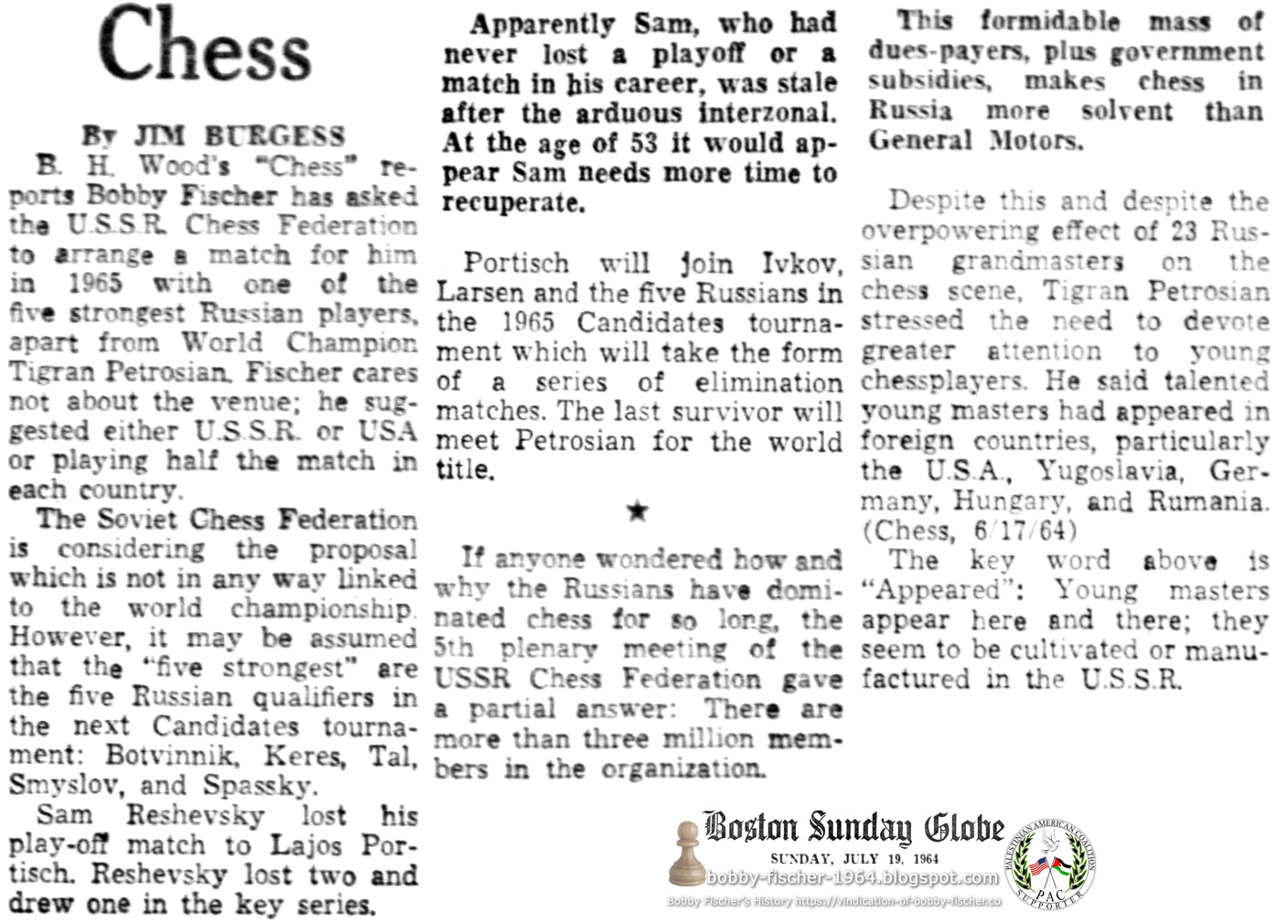
B. H. Wood's “Chess” reports Bobby Fischer has asked the USSR Chess Federation to arrange a match for him in 1965 with one of the five strongest Russian players apart from World Champion Tigran Petrosian. Fischer cares not about the venue; he suggested either U.S.S.R. or USA or playing half the match in each country.
The Soviet Chess Federation is considering the proposal which is not in any way linked to the world championship. However, it may be assumed that the “five strongest” are the five Russian qualifiers in the next Candidates tournament: Botvinnik, Keres, Tal, Smyslov, and Spassky.
Sam Reshevsky lost his play-off match to Lajos Portisch. Reshevsky lost two and drew one in the key series.
Apparently Sam, who had never lost a playoff or a match in his career, was stale after the arduous interzonal. At the age of 53 it would appear Sam needs more time to recuperate.
Portisch will join Ivkov, Larsen and the five Russians in the 1965 Candidates tournament which will take the form of a series of elimination matches. The last survivor will meet Petrosian for the world title.
If anyone wondered how and why the Russians have dominated chess for so long, the 5th plenary meeting of the USSR Chess Federation gave a partial answer: There are more than three million members in the organization.
This formidable mass of dues-payers, plus government subsidies, makes chess in Russia more solvent than General Motors.
Despite this and despite the overpowering effect of 23 Russian grandmasters on the chess scene, Tigran Petrosian stressed the need to devote greater attention to young chessplayers. He said talented young masters had appeared in foreign countries, particularly the U.S.A., Yugoslavia, Germany, Hungary, and Rumania. (Chess, 6/17/64)
The key word above is “Appeared”: Young masters appear here and there; they seem to be cultivated or manufactured in the U.S.S.R.

Bobby Fischer Asks Soviet Chess Federation to Arrange Match With Strongest Russian Player

Entries in Interzonal

Back to 1964 News Articles

The Boston Globe Boston, Massachusetts Sunday, May 24, 1964 - Page 4

Entries in Interzonal
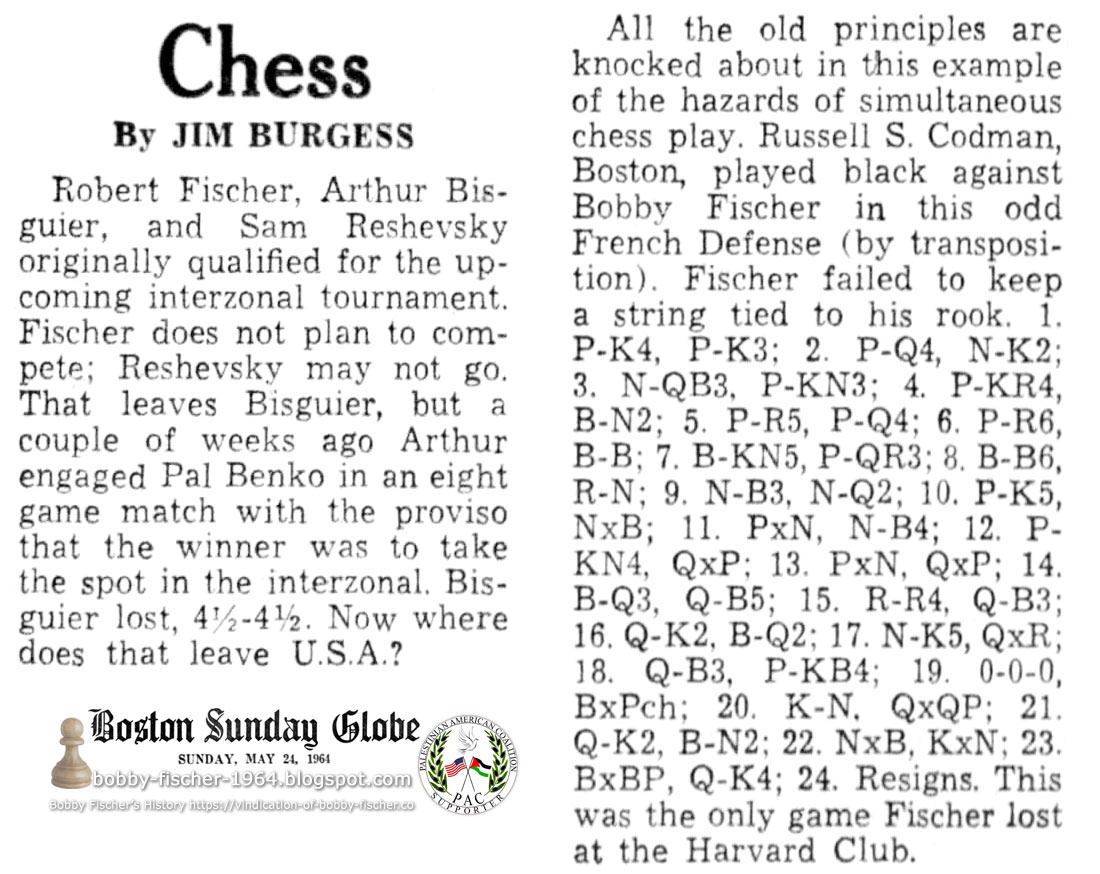
Robert Fischer, Arthur Bisguier, and Sam Reshevsky originally qualified for the upcoming interzonal tournament. Fischer does not plan to compete; Reshevsky may not go. That leaves Bisguier, but a couple of weeks ago Arthur engaged Pal Benko in an eight game match with the proviso that the winner was to take the spot in the interzonal. Bisguier lost, 4½-4½. Now where does that leave U.S.A.?
All the old principles are knocked about in this example of the hazards of simultaneous chess play. Russell S. Codman, Boston, played black against Bobby Fischer in this odd French Defense (by transposition). Fischer failed to keep a string tied to his rook …

Entries in Interzonal

Four-Way Tie in First Place in the Sixth Interzonal Tournament

Back to 1964 News Articles

The Boston Globe Boston, Massachusetts Sunday, July 05, 1964 - Page 42

Four-Way Tie in First Place in the Sixth Interzonal Tournament
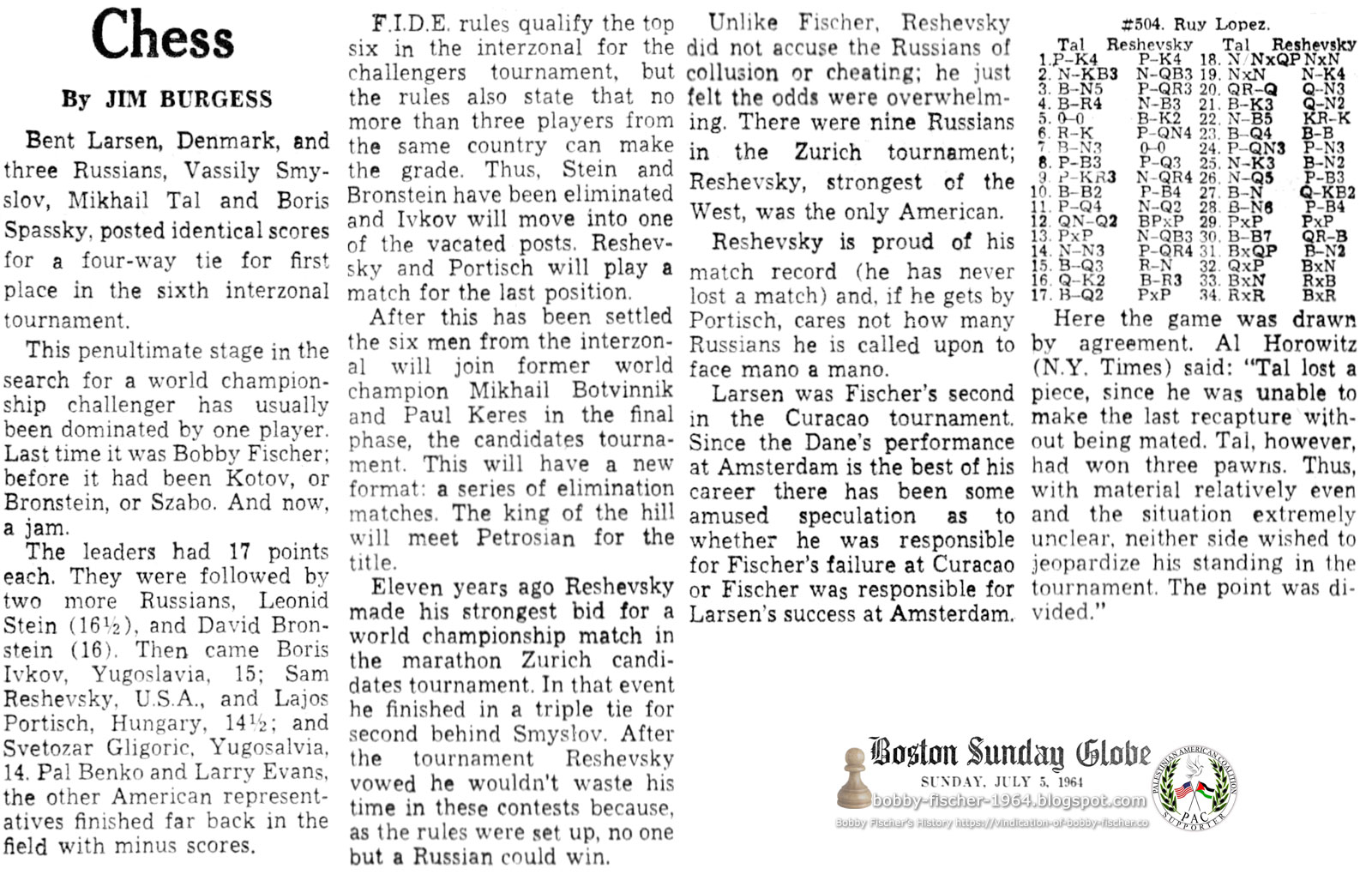
Bent Larsen, Denmark, and three Russians, Vassily Smyslov, Mikhail Tal and Boris Spassky, posted identical scores for a four-way tie for first place in the sixth interzonal tournament.
This penultimate stage in the search for a world championship challenger has usually been dominated by one player. Last time it was Bobby Fischer; before it had been Kotov, or Bronstein, or Szabo. And now, a jam.
The leaders had 17 points each. They were followed by two more Russians, Leonid Stein (16½), and David Bronstein (16). Then came Boris Ivkov, Yugoslavia, 15; Sam Reshevsky. U.S.A., and Lajos Portisch, Hungary, 14½: and Svetozar Gligoric, Yugoslavia, 14. Pal Benko and Larry Evans, the other American representatives finished far back in the field with minus scores.
F.I.D.E. rules qualify the top six in the interzonal for the challengers tournament, but the rules also state that no more than three players from the same country can make the grade. Thus, Stein and Bronstein have been eliminated and Ivkov will move into one of the vacated posts. Reshevsky and Portisch will play a match for the last position.
After this has been settled the six men from the interzonal will join former world champion Mikhail Botvinnik and Paul Keres in the final phase, the candidates tournament. This will have a new format: a series of elimination matches. The king of the hill will meet Petrosian for the title.
Eleven years ago Reshevsky made his strongest bid for a world championship match in the marathon Zurich candidates tournament. In that event he finished in a triple tie for second behind Smyslov. After the tournament Reshevsky vowed he wouldn't waste his time in these contests because, as the rules were set up, no one but a Russian could win.
Unlike Fischer, Reshevsky did not accuse the Russians of collusion or cheating; he just felt the odds were overwhelming. There were nine Russians in the Zurich tournament; Reshevsky, strongest of the West, was the only American.
Reshevsky is proud of his match record (he has never lost a match) and, if he gets by Portisch, cares not how many Russians he is called upon to face mano a mano.
Larsen was Fischer's second in the Curacao tournament. Since the Dane's performance at Amsterdam is the best of his career there has been some amused speculation as to whether he was responsible for Fischer's failure at Curacao or Fischer was responsible for Larsen's success at Amsterdam.
Here the game was drawn by agreement. Al Horowitz (N.Y. Times) said: “Tal lost a piece, since he was unable to make the last recapture with-out being mated. Tal, however, had won three pawns. Thus, with material relatively even and the situation extremely unclear, neither side wished to jeopardize his standing in the tournament. The point was divided.”

Four-Way Tie in First Place in the Sixth Interzonal Tournament

Benko Vs. Bisguier

Back to 1964 News Articles

The Los Angeles Times Los Angeles, California Sunday, May 10, 1964 - Page 88

Benko Vs. Bisguier
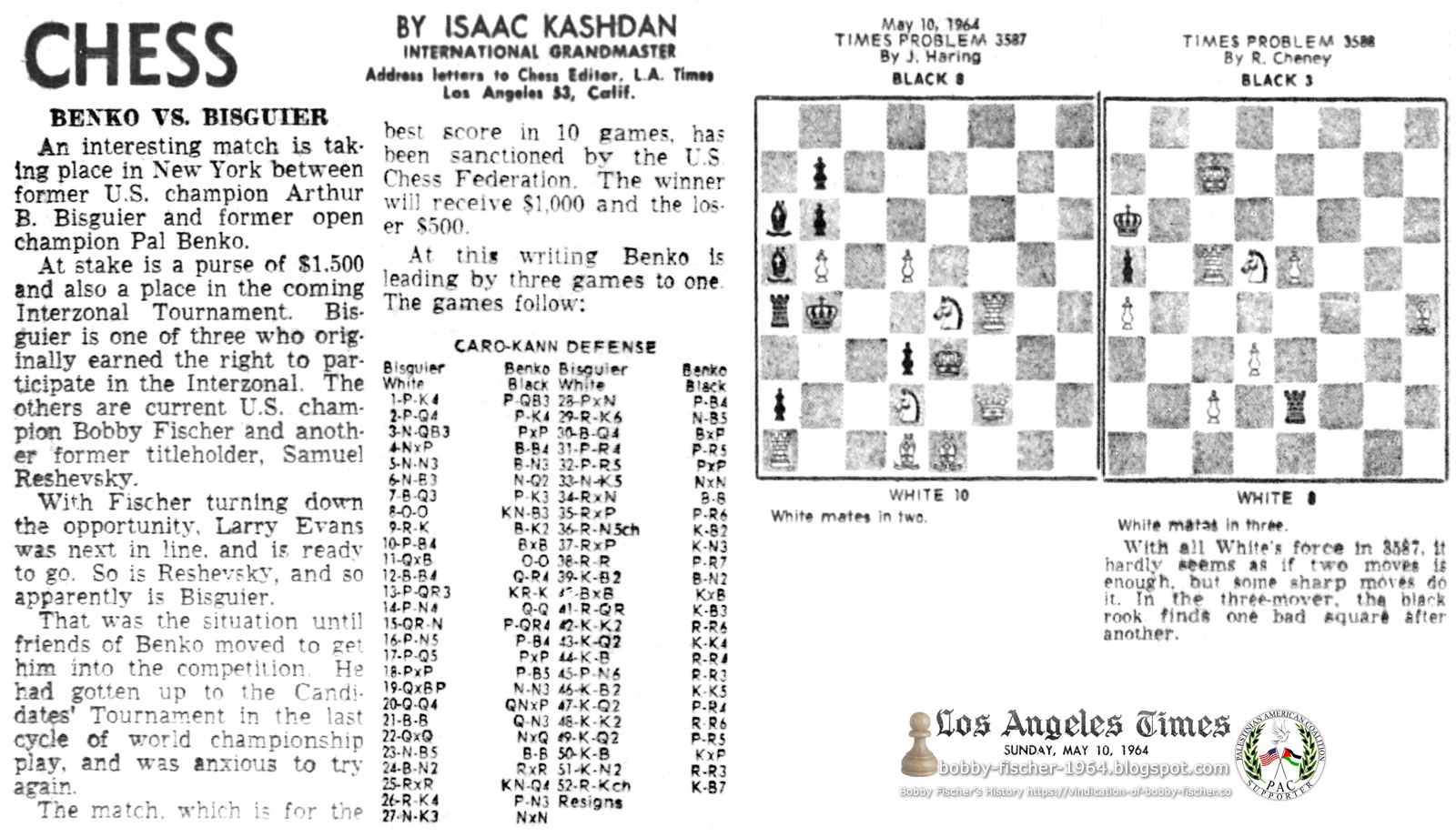
An interesting match is taking place in New York between former U.S. champion Arthur B. Bisguier and former open champion Pal Benko.
At stake is a purse of $1,500 and also a place in the coming Interzonal Tournament. Bisguier is one of three who originally earned the right to participate in the Interzonal. The others are current U.S. champion Bobby Fischer and another former titleholder, Samuel Reshevsky.
With Fischer turning down the opportunity, Larry Evans was next in line, and is ready to go. So is Reshevsky, and so apparently is Bisguier.
That was the situation until friends of Benko moved to get him into the competition. He had gotten up to the Candidates' Tournament in the last cycle of world championship play, and was anxious to try again.
The match, which is for the best score in 10 games, has been sanctioned by the U.S Chess Federation. The winner will receive $1,000 and the loser $500.
At this writing Benko is leading by three games to one.
The games follow:

Benko Vs. Bisguier

Chess Champ Withdraws

Back to 1964 News Articles

Wilkes-Barre Times Leader, the Evening News, Wilkes-Barre Record Wilkes-Barre, Pennsylvania Wednesday, May 20, 1964 - Page 42

Chess Champ Withdraws
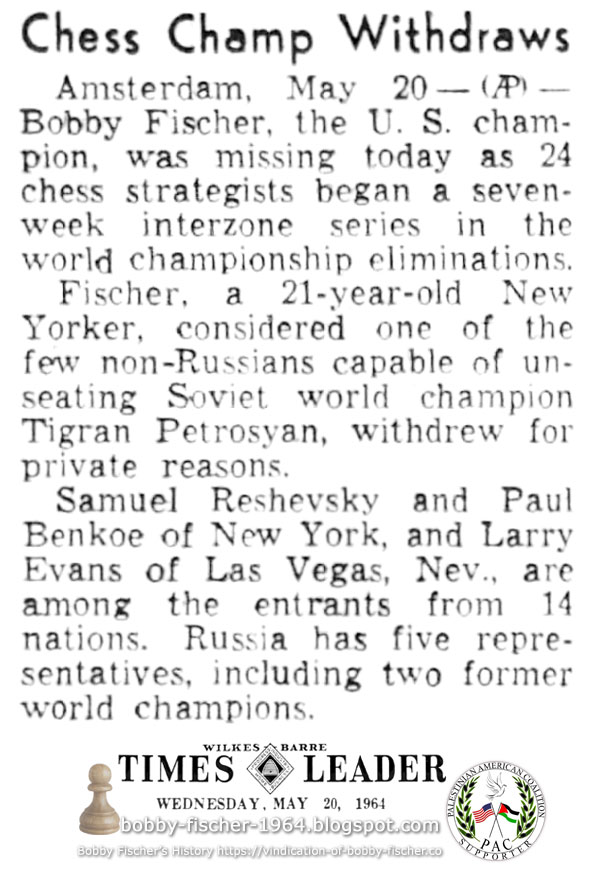
Amsterdam, May 20 — (AP) — Bobby Fischer, the U.S. champion, was missing today as 24 chess strategists began a seven-week interzone series in the world championship eliminations.
Fischer, a 21-year-old New Yorker, considered one of the few non-Russians capable of unseating Soviet world champion Tigran Petrosyan, withdrew for private reasons.
Samuel Reshevsky and Paul Benkoe of New York, and Larry Evans of Las Vegas, Nev., are among the entrants from 14 nations. Russia has five representatives, including two former world champions.

Chess Champ Withdraws

Child Prodigies and Diminutives

Back to 1964 News Articles

The Boston Globe Boston, Massachusetts Sunday, May 03, 1964 - Page 59

Child Prodigies and Diminutives
Rev. George L. Paine, Cambridge, anticipates a full house for the Robert J. Fischer exhibition at Harvard Club next Sunday. Dr. Paine said: “But to be sure of getting your place at the table you had better promptly send in your check for $4, made out to the Harvard Club and labeled ‘for Chess Exhibition’. First come, first served.”
Note the reference to Robert J. Fischer above. No more Bobby. Reader Jack Stone, Baltimore, wrote to Chess Review complaining about the innate lack of dignity in these “childish diminutives.” He referred specifically to Bobby as in Fischer and Sammy as in Reshevsky. And he wanted to know if anyone had ever called Emanuel Lasker, Manny or Jose Raul Capablanca y Graupera, Joey. Chess Review's editor answered that these affectionate diminutives seem to apply only to child prodigies. He signed the answer Eddie.

Child Prodigies and Diminutives

The Larger Chessboard

Back to 1964 News Articles

The Record Hackensack, New Jersey Thursday, January 09, 1964 - Page 50 (★)

The Larger Chessboard
Bobby Fischer, the 20-year-old United States chess champion, broke a lot of records in the recently completed national tournament in New York. Since he was 14, when he first captured the title, he has won the championship six times. That breaks a deadlock with Samuel Reshevsky of Spring Valley, a 5-time winner. Young Mr. Fischer won 11 straight games, a perfect score and the first in a major tournament in this country in 70 years. (Dr. Emanuel Lasker won 13 games in a row in 1893.) This man Fischer is a redoubtable champion — in our small corner of the world of chess.
Next comes to mind the world championship tournament, the first games of which are to be played in Holland next June.
The latest six world champions have been from the Soviet Union. The United States has never had an official winner.
This is not the time for Bobby Fischer to rest on his record. The Russians have invaded basketball, hockey, yachting. On, Robert, to Holland!

The Larger Chessboard

Interzonal Tournament Roll

Back to 1964 News Articles

Daily Press Newport News, Virginia Sunday, June 14, 1964 - Page 82

Interzonal Tournament Roll
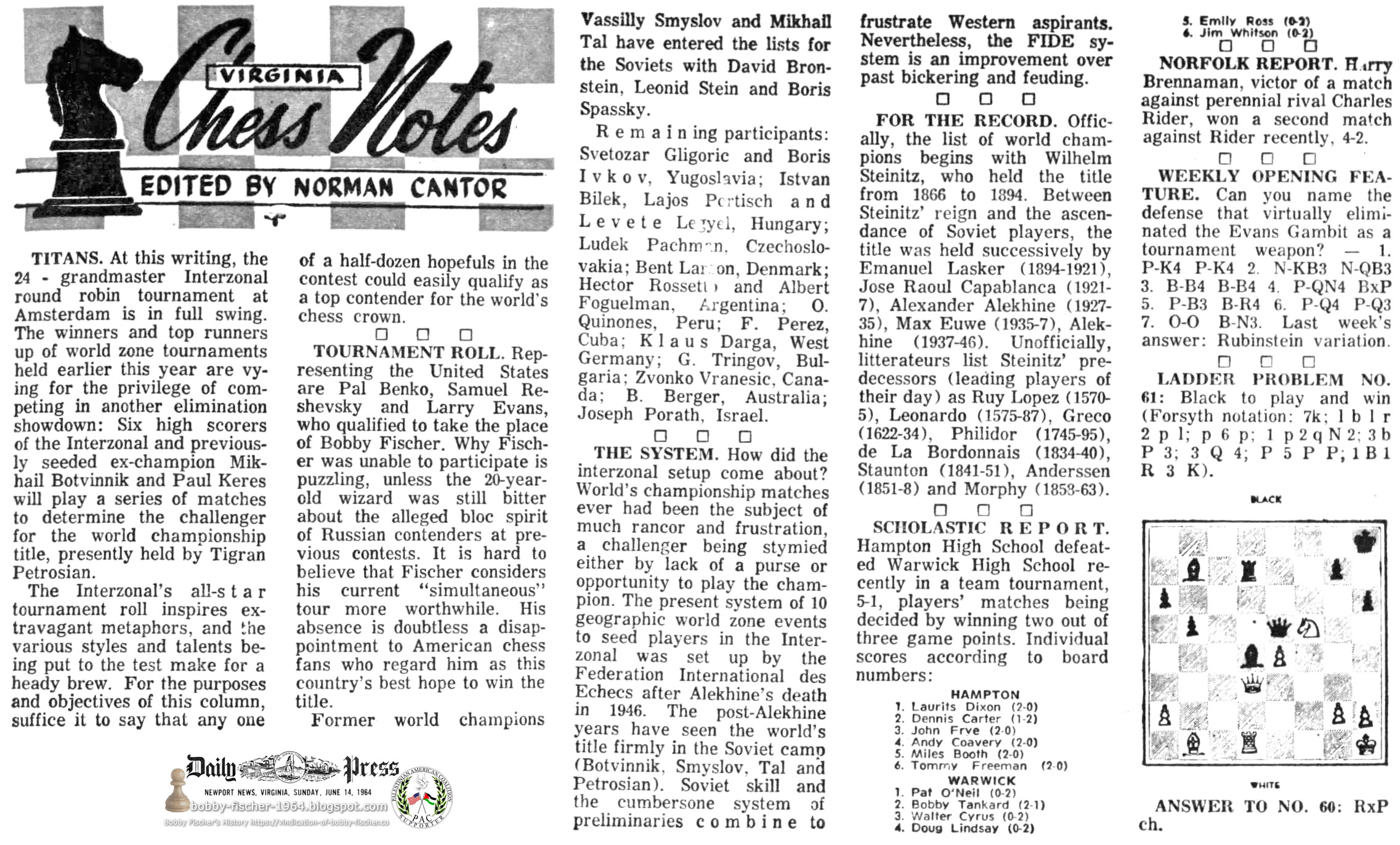
“…Representing the United States are Pal Benko, Samuel Reshevsky and Larry Evans, who qualified to take the place of Bobby Fischer. Why Fischer was unable to participate is puzzling, unless the 20-year-old wizard was still bitter about the alleged bloc spirit of Russian contenders at previous contests. It is hard to believe that Fischer considers his current “simultaneous” tour more worthwhile. His absence is doubtless a disappointment to American chess fans who regard him as this country's best hope to win the title.”

Interzonal Tournament Roll

20-Year-Old U.S. Chess Champion To Lecture, Play 50 Opponents

Back to 1964 News Articles

Hartford Courant Hartford, Connecticut Saturday, February 29, 1964 - Page 9

20-Year-Old U.S. Chess Champion To Lecture, Play 50 Opponents
Bobby Fischer, 20-year-old U.S. Chess Champion, and considered by many as the greatest natural chess player in history, will lecture in Hartford Tuesday night and play an exhibition match simultaneously against 50 opponents.
Fischer won the U.S. championships for the sixth time last month. His 11-0 victory was the first perfect score in major U.S. tournaments in the past 70 years. Fischer first won the U.S. championship when he was 14.
Known as the “stormy petrel” of the chess world,” Fischer is almost constantly in difficulties with chess officialdom.

Withdrew in 1959
In 1959 he withdrew from the U.S. championships because of what he considered an unfair system of pairings.
In 1962 Fischer accused Russian chess players, who sued him for libel, of “pre-arranging games at tournaments. He was the first person to say publicly what many American chess players said privately.
Samuel Reshevsky, five-time U.S. chess champion, agreed with him that the present world chess championships are “unjust and unfair.”
Fischer claimed that Russian chess players do not play as individuals but as a team, and that they throw points to one another when necessary in the tournaments.
ance at 7 p.m. at the Shoreham Motor Hotel is part of his national tour before going to the world championship tournament in Europe in June.

20-Year-Old U.S. Chess Champion To Lecture, Play 50 Opponents

Chessworld Magazine

Back to 1964 News Articles

Sunday Gazette-Mail Charleston, West Virginia Sunday, March 15, 1964 - Page 21

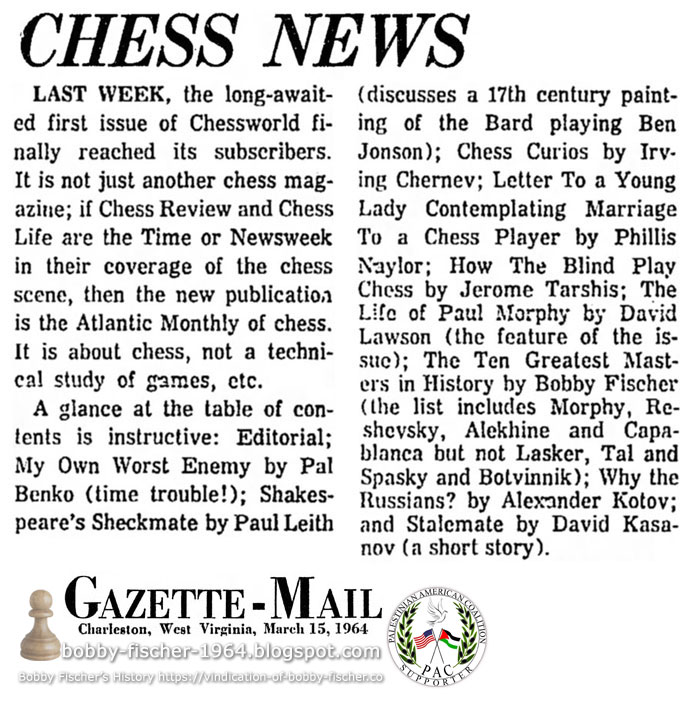
“The Ten Greatest Masters in History by Bobby Fischer (the list includes Morphy, Reshevsky, Alekhine and Capablanca but not Lasker, Tal and Spassky and Botvinnik).

Chessworld Magazine

21 Chess Players Bite Dust

Back to 1964 News Articles

The Minneapolis Star Minneapolis, Minnesota Wednesday, February 19, 1964 - Page 17

21 Chess Players Bite Dust
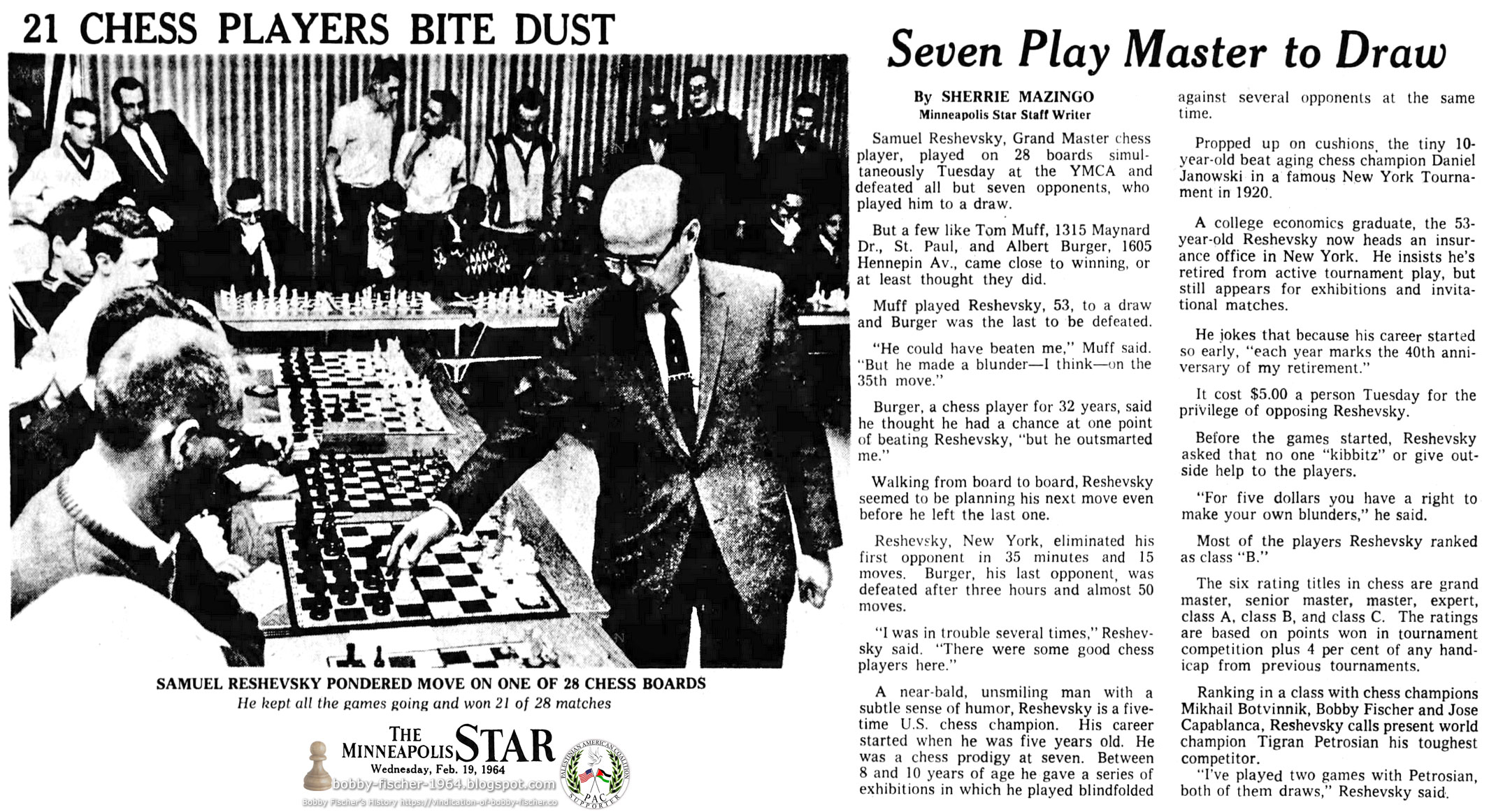
“Ranking in a class with chess champions Mikhail Botvinnik, Bobby Fischer and Jose Capablanca, Reshevsky calls present world champion Tigran Petrosian his toughest competitor.
‘I've played two games with Petrosian, both of them draws,’ Reshevsky said.”

21 Chess Players Bite Dust

Kashdan to Captain Chess Olympic Team and Fischer to Visit Los Angeles

Back to 1964 News Articles

The Los Angeles Times Los Angeles, California Sunday, February 16, 1964 - Page 78

Kashdan to Captain Chess Olympic Team and Fischer to Visit Los Angeles
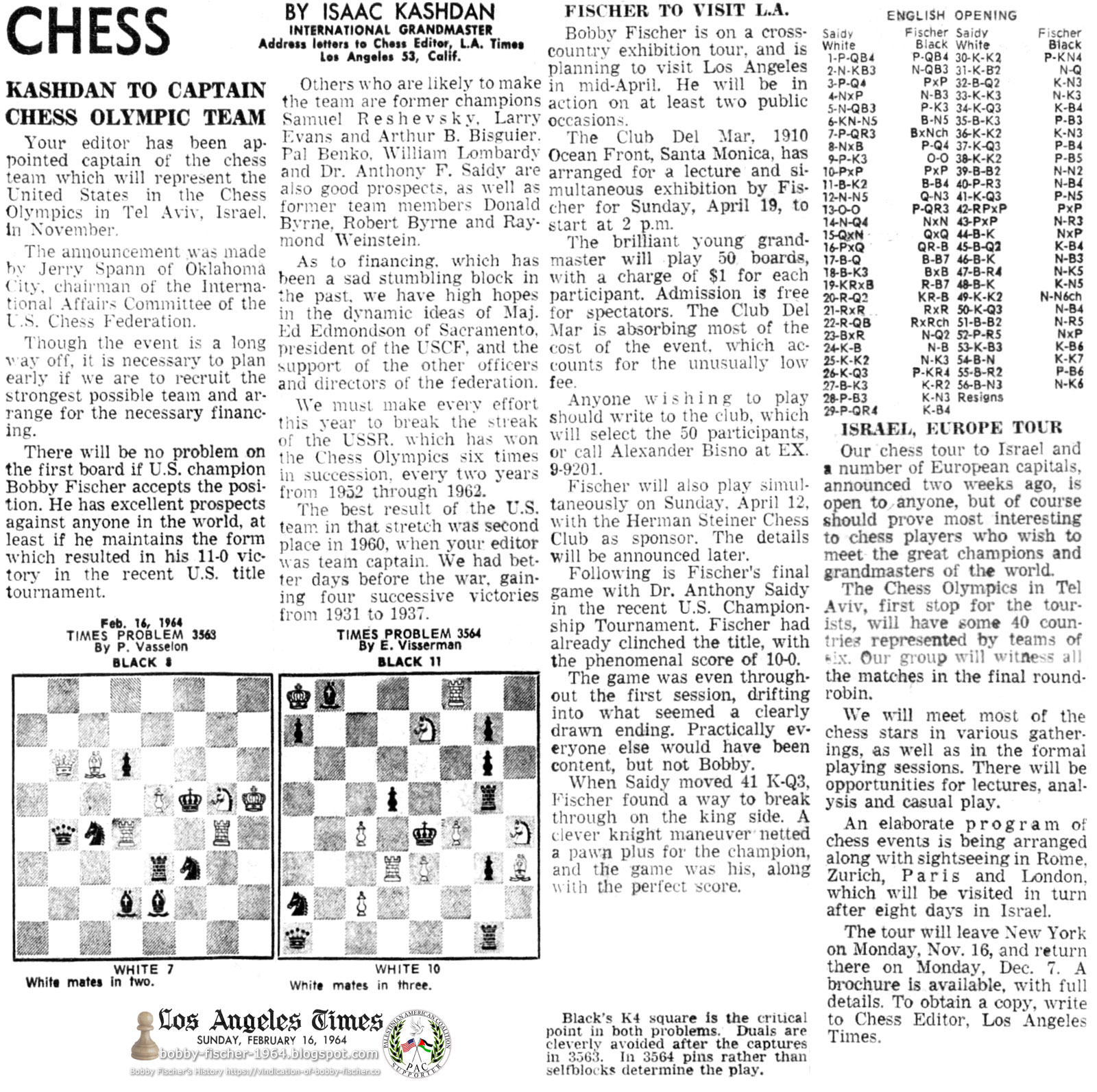
“There will be no problem on the first board if U.S. champion Bobby Fischer accepts the position. He has excellent prospects against anyone in the world, at least if he maintains the form which resulted in his 11-0 victory in the recent U.S. title tournament.
Others who are likely to make the team are former champions Samuel Reshevsky, Larry Evans and Arthur B. Bisguier, Pal Benko, William Lombardy, and Dr. Anthony F. Saidy are also good prospects, as well as former team members Donald Byrne, Robert Byrne and Raymond Weinstein.
As to financing, which has been a sad stumbling block in the past, we have high hopes in the dynamic ideas of Maj. Ed Edmondson of Sacramento, president of the USCF, and the support of the other officers and directors of the federation.
We must make every effort this year to break the streak of the USSR, which has won the Chess Olympics six times in succession, every two years from 1952 through 1962.
The best result of the U.S. team in that stretch was second place in 1960, when your editor was team captain. We had better days before the war, gaining four successive victories from 1931 to 1937.

Fischer to Visit L.A.
Bobby Fischer is on a cross-country exhibition tour, and is planning to visit Los Angeles in mid-April. He will be in action on at least two public occasions.
The Club Del Mar, 1910 Ocean Front, Santa Monica, has arranged for a lecture and simultaneous exhibition by Fischer for Sunday, April 19, to start at 2 p.m.
The brilliant young grandmaster will play 50 boards, with a charge of $1 for each participant. Admission is free for spectators. The Club Del Mar is absorbing most of the cost of the event, which accounts for the unusually low fee.
Anyone wishing to play should write to the club, which will select the 50 participants, or call Alexander Bisno at EX. 9-9201.
Fischer will also play simultaneously on Sunday, April 12, with the Herman Steiner Chess Club as sponsor. The details will be announced later.
Following is Fischer's final game with Dr. Anthony Saidy in the recent U.S. Championship Tournament. Fischer had already clinched the title, with the phenomenal score of 10-0.
The game was even throughout the first session, drifting into what seemed a clearly drawn ending. Practically everyone else would have been content, but not Bobby.
When Saidy moved 41 K-Q3, Fischer found a way to break through on the king side. A clever knight maneuver netted a pawn plus for the champion, and the game was his, along with the perfect score.

Kashdan to Captain Chess Olympic Team and Fischer to Visit Los Angeles

Reshevsky Takes on 60 in Detroit

Back to 1964 News Articles

Detroit Free Press Detroit, Michigan Friday, February 21, 1964 - Page 48

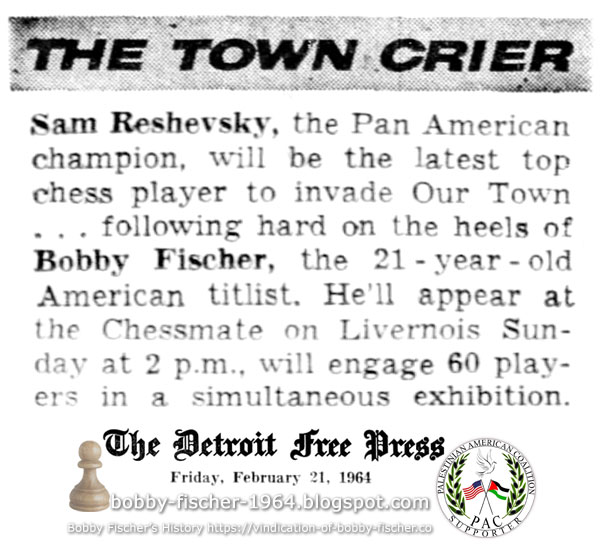
“Sam Reshevsky, the Pan American champion, will be the latest top chess player to invade Our Town… following hard on the heels of Bobby Fischer, the 21-year-old American titlist. He'll appear at the Chessmate on Livernois Sunday at 2 p.m., will engage 60 players in a simultaneous exhibition.”

Reshevsky Takes on 60 in Detroit

Simultaneous Exhibition at Woodstock School

Back to 1964 News Articles

The Kingston Daily Freeman Kingston, New York Wednesday, February 05, 1964 - Page 11

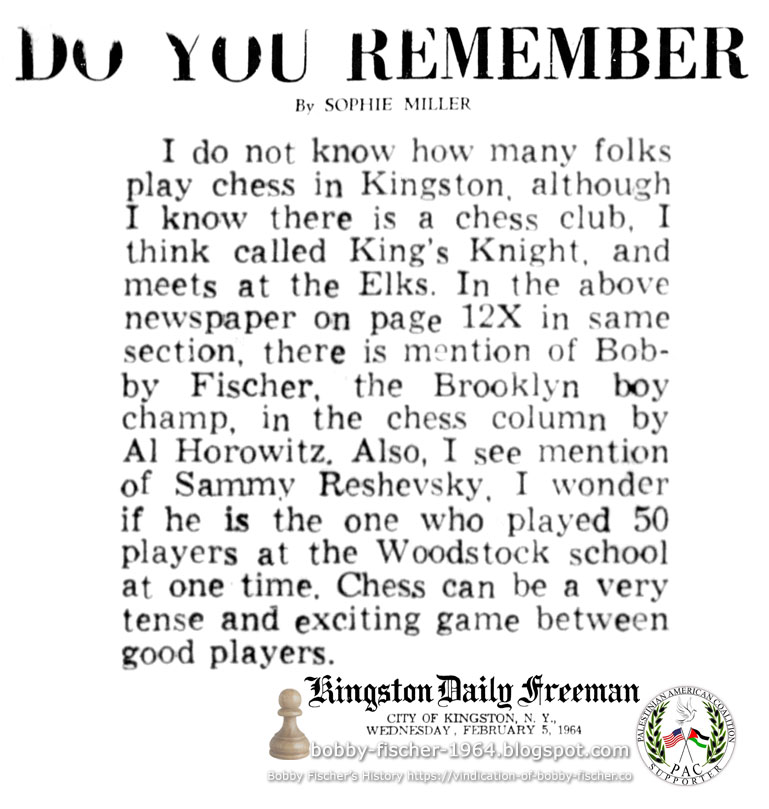
Do You Remember By Sophie Miller
“I do not know how many folks play chess in Kingston, although I know there is a chess club. I think called King's Knight, and meets at the Elks. In the above newspaper on page 12X in same section, there is mention of Bobby Fischer, the Brooklyn boy champ, in the chess column by Al Horowitz. Also, I see mention of Sammy Reshevsky. I wonder if he is the one who played 50 players at the Woodstock school at one time. Chess can be a very tense and exciting game between good players.”

Simultaneous Exhibition at Woodstock School

Chess: Evans, Strong on Theory, Is Powerful Over the Board Too

Back to 1964 News Articles

New York Times, New York, New York, Monday, January 13, 1964 - Page 32

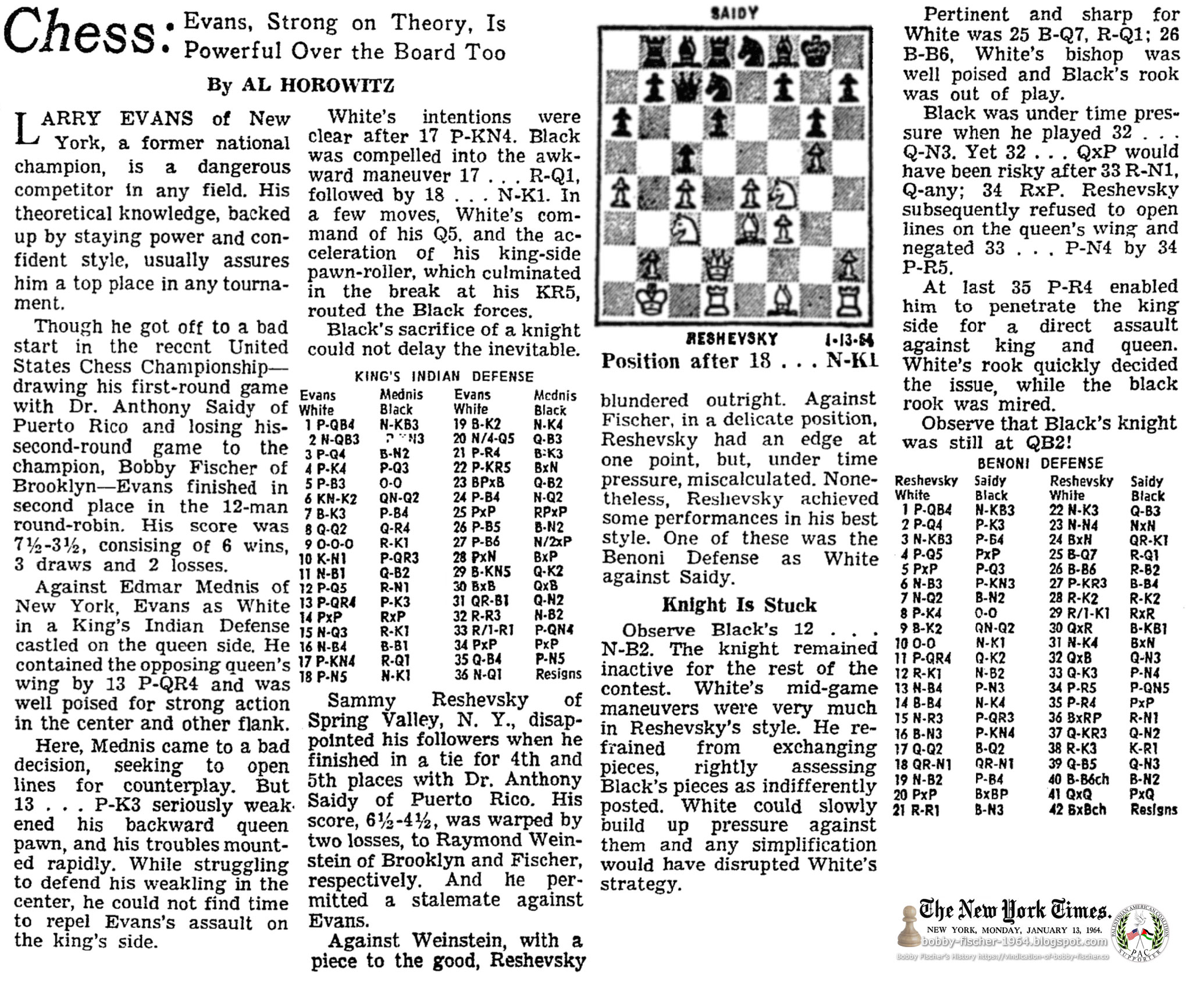
Chess: Evans, Strong on Theory, Is Powerful Over the Board Too
Larry Evans of New York, a former national champion, is a dangerous competitor in any field. His theoretical knowledge, backed up by staying power and confident style, usually assures him a top place in any tournament.
Though he got off to a bad start in the recent United States Chess Championship—drawing his first-round game with Dr. Anthony Saidy of Puerto Rico and losing his second-round game to the champion, Bobby Fischer of Brooklyn—Evans finished in second place in the 12-man round-robin. His score was 7½-3½, consisting of 6 wins, 3 draws and 2 losses.
Against Edmar Mednis of New York, Evans as White in a King's Indian Defense castled on the queen side. He contained the opposing queen's wing by 13 P-QR4 and was well poised for strong action in the center and other flank.
Here, Mednis came to a bad decision, seeking to open lines for counterplay. But 13 … P-K3 seriously weakened his backward queen pawn, and his troubles mounted rapidly. While struggling to defend his weakling in the center, he could not find time to repel Evan's assault on the king's side.
White's intentions were clear after 17 P-KN4. Black was compelled into the awkward maneuver 17 … R-Q1, followed by 18 … N-K1. In a few moves, White's command of his Q5, and the acceleration of his king-side pawn-roller, which culminated in the break at his KR5, routed the Black forces.
Black's sacrifice of a knight could not delay the inevitable.
Sammy Reshevsky of Spring Valley, N.Y., disappointed his followers when he finished in a tie for 4th and 5th places with Dr. Anthony Saidy of Puerto Rico. His score, 6½-4½, was warped by two losses, to Raymond Weinstein of Brooklyn and Fischer, respectively. And he permitted a stalemate against Evans.
Against Weinstein, with a piece to the good, Reshevsky blundered outright. Against Fischer, in a delicate position, Reshevsky had an edge at one point, but, under time pressure, miscalculated. Nonetheless, Reshevsky achieved some performances in his best style. One of these was the Benoni Defense as White against Saidy.

Knight Is Stuck
Observe Black's 12…

Chess: Evans, Strong on Theory, Is Powerful Over the Board Too

Fischer Tops Field Here By 3½ Points

Back to 1964 News Articles

New York Times, New York, New York, Monday, January 06, 1964 - Page 44

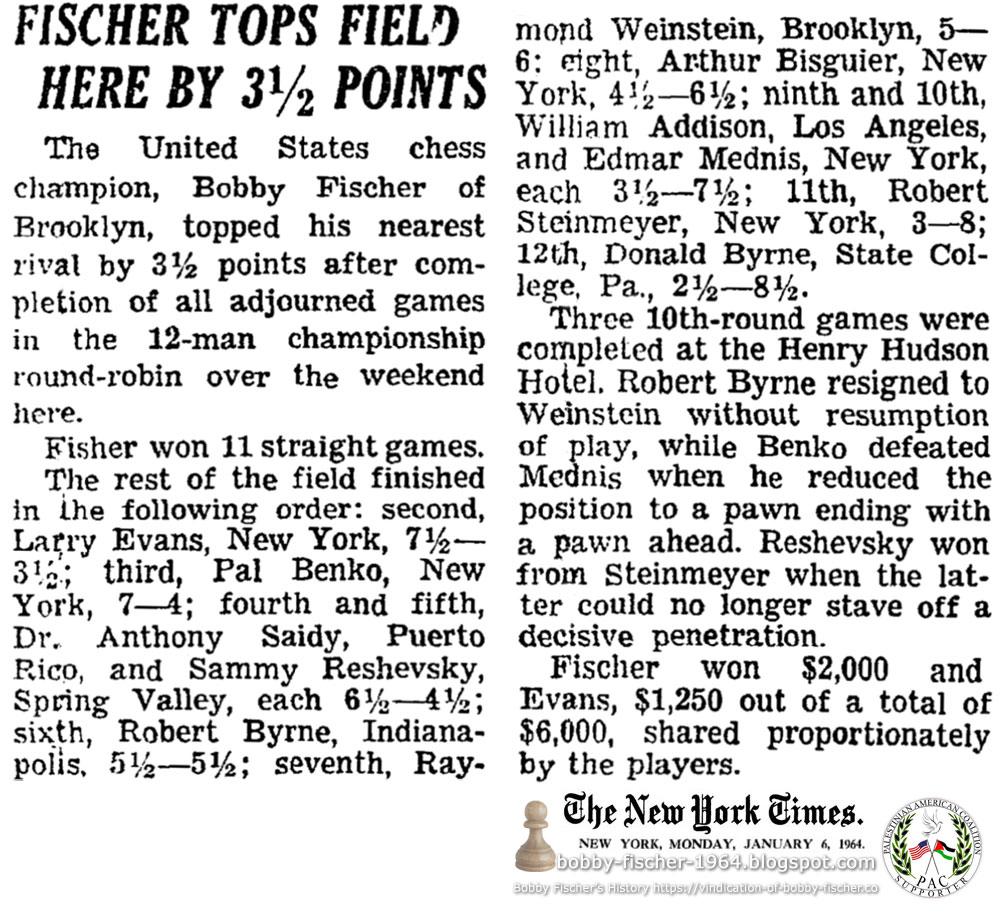
Fischer Tops Field Here By 3½ Points
The United States chess champion, Bobby Fischer of Brooklyn, topped his nearest rival by 3½ points after completion of all adjourned games in the 12-man championship round-robin over the weekend here.
Fischer won 11 straight games.
The rest of the field finished in the following order: second, Larry Evans, New York, 7½—3½; third, Pal Benko, New York, 7—4; fourth and fifth, Dr. Anthony Saidy, Puerto Rico, and Sammy Reshevsky, Spring Valley, each 6½—4½; sixth, Robert Byrne, Indianapolis, 5½—5½; seventh, Raymond Weinstein, Brooklyn, 5—6: eight, Arthur Bisguier, New York, 4½—6½; ninth and 10th William Addison, Los Angeles, and Edmar Mednis, New York, each 3½—7½; 11th, Robert Steinmeyer, New York, 3—8; 12th, Donald Byrne, State College, Pa., 2½—8½.
Three 10th-round games were completed at the Henry Hudson Hotel. Robert Byrne resigned to Weinstein without resumption of play, while Benko defeated Mednis when he reduced the position to a pawn ending with a pawn ahead. Reshevsky won from Steinmeyer when the latter could no longer stave off a decisive penetration.
Fischer won $2,000 and Evans $1,250 out of a total of $6,000, shared proportionately by the players.

Fischer Tops Field Here By 3½ Points

Recommended Books

Understanding Chess by William Lombardy Chess Duels, My Games with the World Champions, by Yasser Seirawan No Regrets: Fischer-Spassky 1992, by Yasser Seirawan Chess Fundamentals, by Jose Capablanca Bobby Fischer Teaches Chess, by Bobby Fischer My 60 Memorable Games, by Bobby Fischer Bobby Fischer Games of Chess, by Bobby Fischer The Modern Chess Self Tutor, by David Bronstein Russians versus Fischer, by Mikhail Tal, Plisetsky, Taimanov, et al

'til the world understands why Robert J. Fischer criticised the U.S./British and Russian military industry imperial alliance and their own Israeli Apartheid. Sarah Wilkinson explains:

Bobby Fischer, First Amendment, Freedom of Speech
“What a sad story Fischer was,” typed a racist, pro-imperialist colonial troll who supports mega-corporation entities over human rights, police state policies & white supremacy.
To which I replied: “Really? I think he [Bob Fischer] stood up to the broken system of corruption and raised awareness! Whether on the Palestinian/Israel-British-U.S. Imperial Apartheid scam, the Bush wars of ‘7 countries in 5 years,’ illegally, unconstitutionally which constituted mass xenocide or his run in with police brutality in Pasadena, California-- right here in the U.S., police run rampant over the Constitution of the U.S., on oath they swore to uphold, but when Americans don't know the law, and the cops either don't know or worse, “don't care” -- then I think that's pretty darn “sad”. I think Mr. Fischer held out and fought the good fight, steadfast til the day he died, and may he Rest In Peace.
Educate yourself about U.S./State Laws --
https://www.youtube.com/@AuditTheAudit/videos
After which the troll posted a string of profanities, confirming there was never any genuine sentiment of “compassion” for Mr. Fischer, rather an intent to inflict further defamatory remarks.

This ongoing work is a tribute to the life and accomplishments of Robert “Bobby” Fischer who passionately loved and studied chess history. May his life continue to inspire many other future generations of chess enthusiasts and kibitzers, alike.

Robert J. Fischer, Kid Chess Wizard 1956March 9, 1943 - January 17, 2008

The photograph of Bobby Fischer (above) from the March 02, 1956 The Tampa Times was discovered by Sharon Mooney (Bobby Fischer Newspaper Archive editor) on February 01, 2018 while gathering research materials for this ongoing newspaper archive project. Along with lost games now being translated into Algebraic notation and extractions from over two centuries of newspapers, it is but one of the many lost treasures to be found in the pages of old newspapers since our social media presence was first established November 11, 2017.

Special Thanks