The Gift of Chess

Notice to commercial publishers seeking use of images from this collection of chess-related archive blogs. For use of the many large color restorations, two conditions must be met: 1) It is YOUR responsibility to obtain written permissions for use from the current holders of rights over the original b/w photo. Then, 2) make a tax-deductible donation to The Gift of Chess in honor of Robert J. Fischer-Newspaper Archives. A donation in the amount of $250 USD or greater is requested for images above 2000 pixels and other special request items. For small images, such as for fair use on personal blogs, all credits must remain intact and a donation is still requested but negotiable. Please direct any photographs for restoration and special request (for best results, scanned and submitted at their highest possible resolution), including any additional questions to S. Mooney, at bobbynewspaperblogs•gmail. As highlighted in the ABC News feature, chess has numerous benefits for individuals, including enhancing critical thinking and problem-solving skills, improving concentration and memory, and promoting social interaction and community building. Initiatives like The Gift of Chess have the potential to bring these benefits to a wider audience, particularly in areas where access to educational and recreational resources is limited.

Best of Chess Fischer Newspaper Archives
• Robert J. Fischer, 1955 ➦
• Robert J. Fischer, 1956 ➦
• Robert J. Fischer, 1957 ➦
• Robert J. Fischer, 1958 ➦
• Robert J. Fischer, 1959 ➦
• Robert J. Fischer, 1960 ➦
• Robert J. Fischer, 1961 ➦
• Robert J. Fischer, 1962 ➦
• Robert J. Fischer, 1963 ➦
• Robert J. Fischer, 1964 ➦
• Robert J. Fischer, 1965 ➦
• Robert J. Fischer, 1966 ➦
• Robert J. Fischer, 1967 ➦
• Robert J. Fischer, 1968 ➦
• Robert J. Fischer, 1969 ➦
• Robert J. Fischer, 1970 ➦
• Robert J. Fischer, 1971 ➦
• Robert J. Fischer, 1972 ➦
• Robert J. Fischer, 1973 ➦
• Robert J. Fischer, 1974 ➦
• Robert J. Fischer, 1975 ➦
• Robert J. Fischer, 1976 ➦
• Robert J. Fischer, 1977 ➦
• Robert J. Fischer, 1978 ➦
• Robert J. Fischer, 1979 ➦
• Robert J. Fischer, 1980 ➦
• Robert J. Fischer, 1981 ➦
• Robert J. Fischer, 1982 ➦
• Robert J. Fischer, 1983 ➦
• Robert J. Fischer, 1984 ➦
• Robert J. Fischer, 1985 ➦
• Robert J. Fischer, 1986 ➦
• Robert J. Fischer, 1987 ➦
• Robert J. Fischer, 1988 ➦
• Robert J. Fischer, 1989 ➦
• Robert J. Fischer, 1990 ➦
• Robert J. Fischer, 1991 ➦
• Robert J. Fischer, 1992 ➦
• Robert J. Fischer, 1993 ➦
• Robert J. Fischer, 1994 ➦
• Robert J. Fischer, 1995 ➦
• Robert J. Fischer, 1996 ➦
• Robert J. Fischer, 1997 ➦
• Robert J. Fischer, 1998 ➦
• Robert J. Fischer, 1999 ➦
• Robert J. Fischer, 2000 ➦
• Robert J. Fischer, 2001 ➦
• Robert J. Fischer, 2002 ➦
• Robert J. Fischer, 2003 ➦
• Robert J. Fischer, 2004 ➦
• Robert J. Fischer, 2005 ➦
• Robert J. Fischer, 2006 ➦
• Robert J. Fischer, 2007 ➦
• Robert J. Fischer, 2008 ➦
Chess Columns
Chessgames.com: Newspaper Chess Games Archive Chess.com: Newspaper Chess Games Archive Facebook: Bobby Fischer History Youtube: Newspaper Chess Games Archive My Life Notes lichess.org: Analyze Chess Game lichess.org: Board Editor Chess Notation Converter Chess.com: Chess Board Analysis Notes
Showing posts with label Paul Morphy. Show all posts

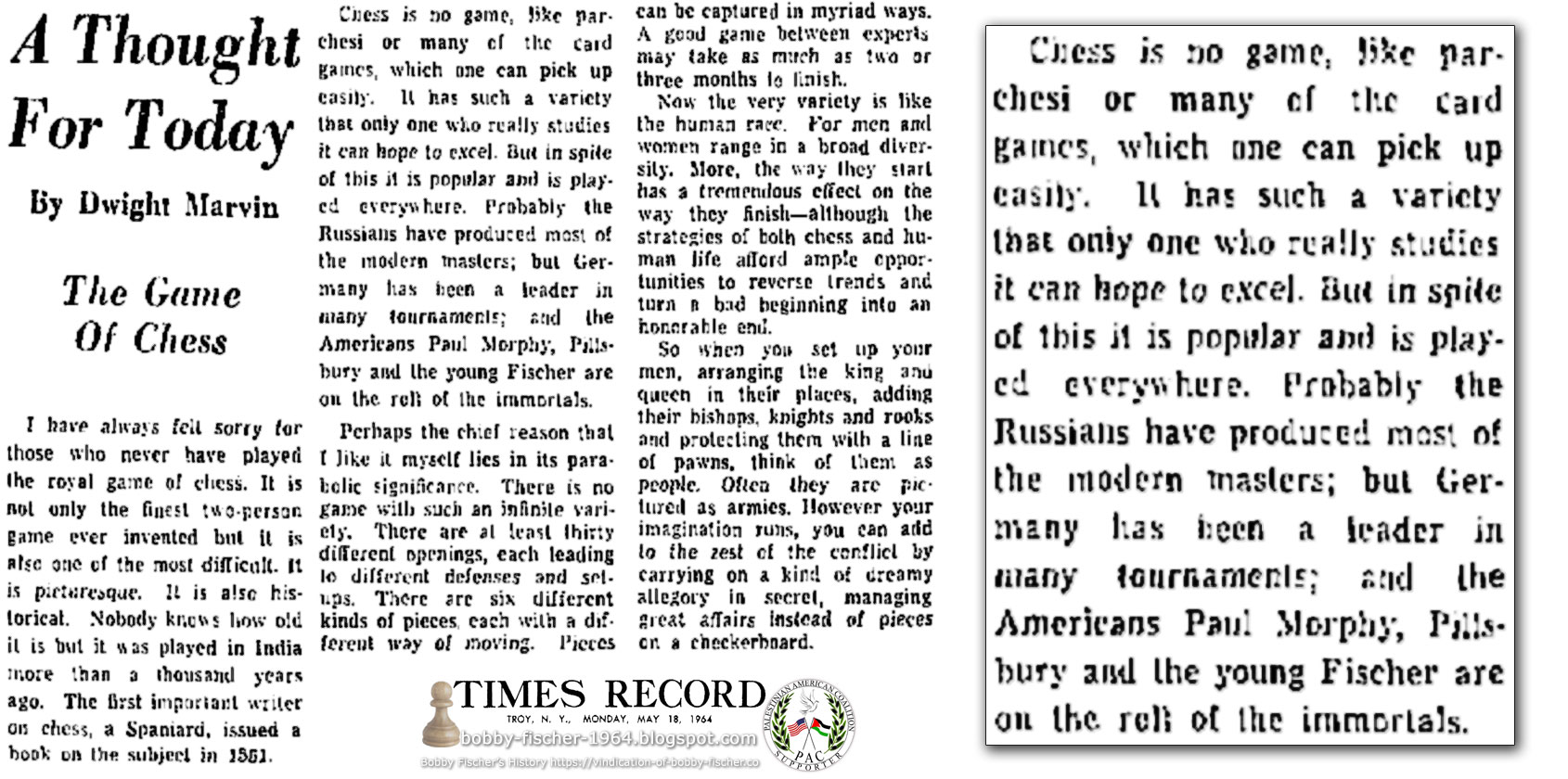
The Game Of Chess

Back to 1964 News Articles

The Troy Record Troy, New York Monday, May 18, 1964 - Page 10 (★)

The Game Of Chess
“…Chess is no game, like Parcheesi or many of the card games, which one can pick up easily. It has such a variety that only one who really studies it can hope to excel. But in spite of this it is popular and is played everywhere. Probably the Russians have produced most of the modern masters; but Germany has been a leader in many tournaments; and the Americans Paul Morphy, Pillsbury and the young Fischer are on the roll of the immortals.”

The Game Of Chess

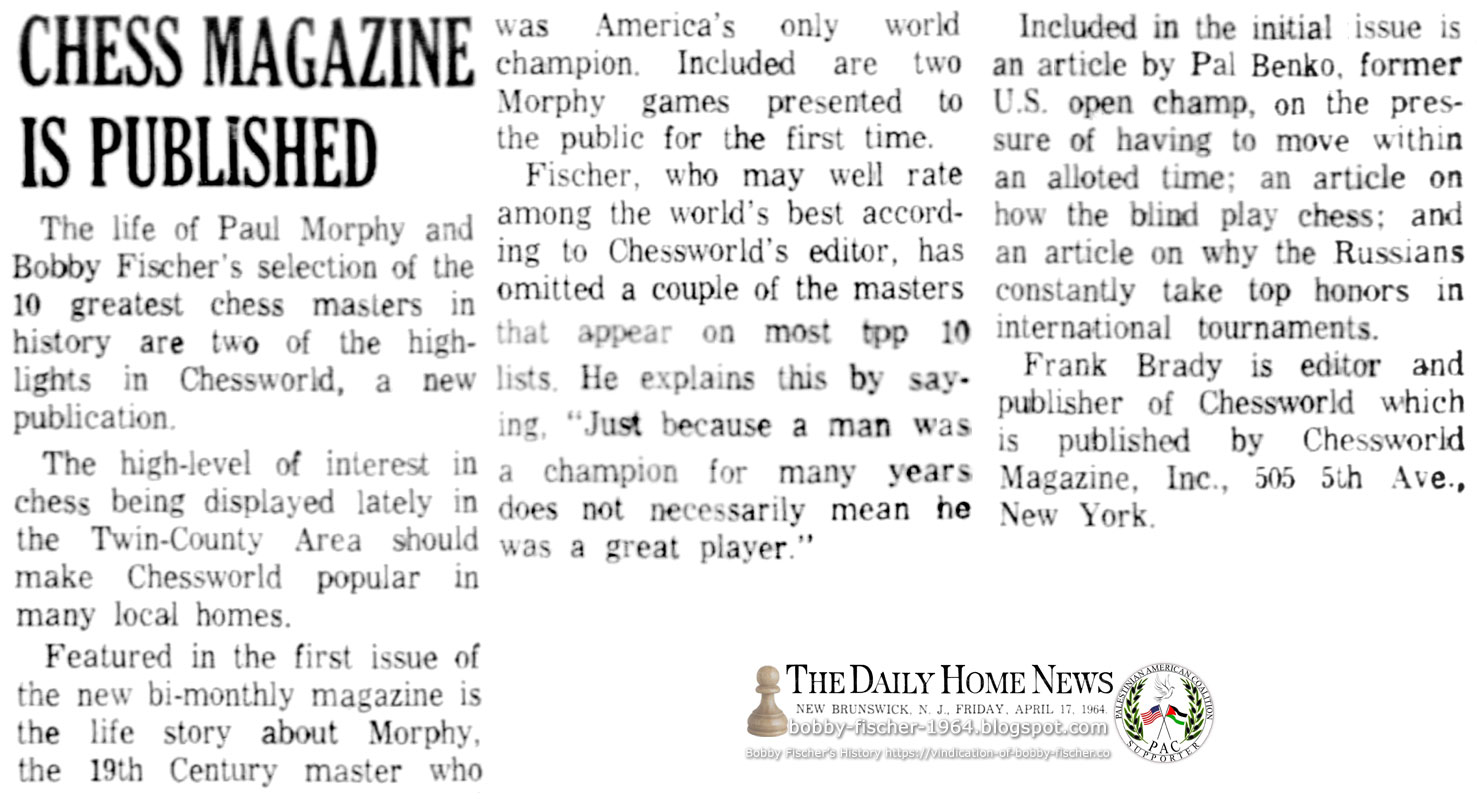
Chess Magazine Is Published

Back to 1964 News Articles

The Central New Jersey Home News New Brunswick, New Jersey Friday, April 17, 1964 - Page 9

Chess Magazine Is Published
The life of Paul Morphy and Bobby Fischer's selection of the 10 greatest chess masters in history are two of the highlights in Chessworld, a new publication.
The high-level of interest in chess being displayed lately in the Twin-County Area should make Chessworld popular in many local homes.
Featured in the first issue of the new bi-monthly magazine is the life story about Morphy, the 19th Century master who was America's only world champion. Included are two Morphy games presented to the public for the first time.
Fischer, who may well rate among the world's best according to Chessworld's editor, has omitted a couple of the masters at appear on most top 10 lists. He explains this by saying, “Just because a man was champion for many years does not necessarily mean he as a great player.”
Included in the initial issue is an article by Pal Benko, former U.S. open champ, on the pressure of having to move within an allotted time; an article on how the blind play chess; and an article on why the Russians constantly take top honors in international tournaments.
Frank Brady is editor and publisher of Chessworld which is published by Chessworld Magazine, Inc., 505 5th Ave., New York.

Chess Magazine Is Published

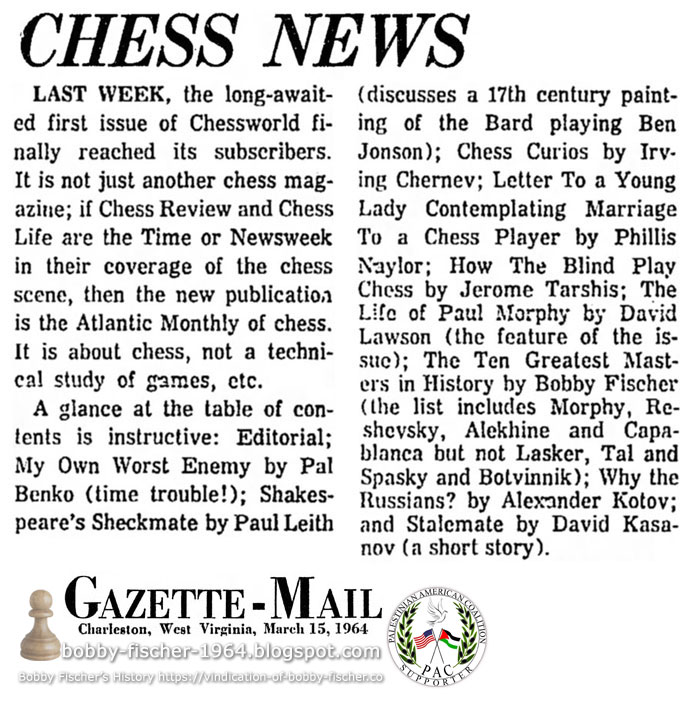
Chessworld Magazine

Back to 1964 News Articles

Sunday Gazette-Mail Charleston, West Virginia Sunday, March 15, 1964 - Page 21

“The Ten Greatest Masters in History by Bobby Fischer (the list includes Morphy, Reshevsky, Alekhine and Capablanca but not Lasker, Tal and Spassky and Botvinnik).

Chessworld Magazine

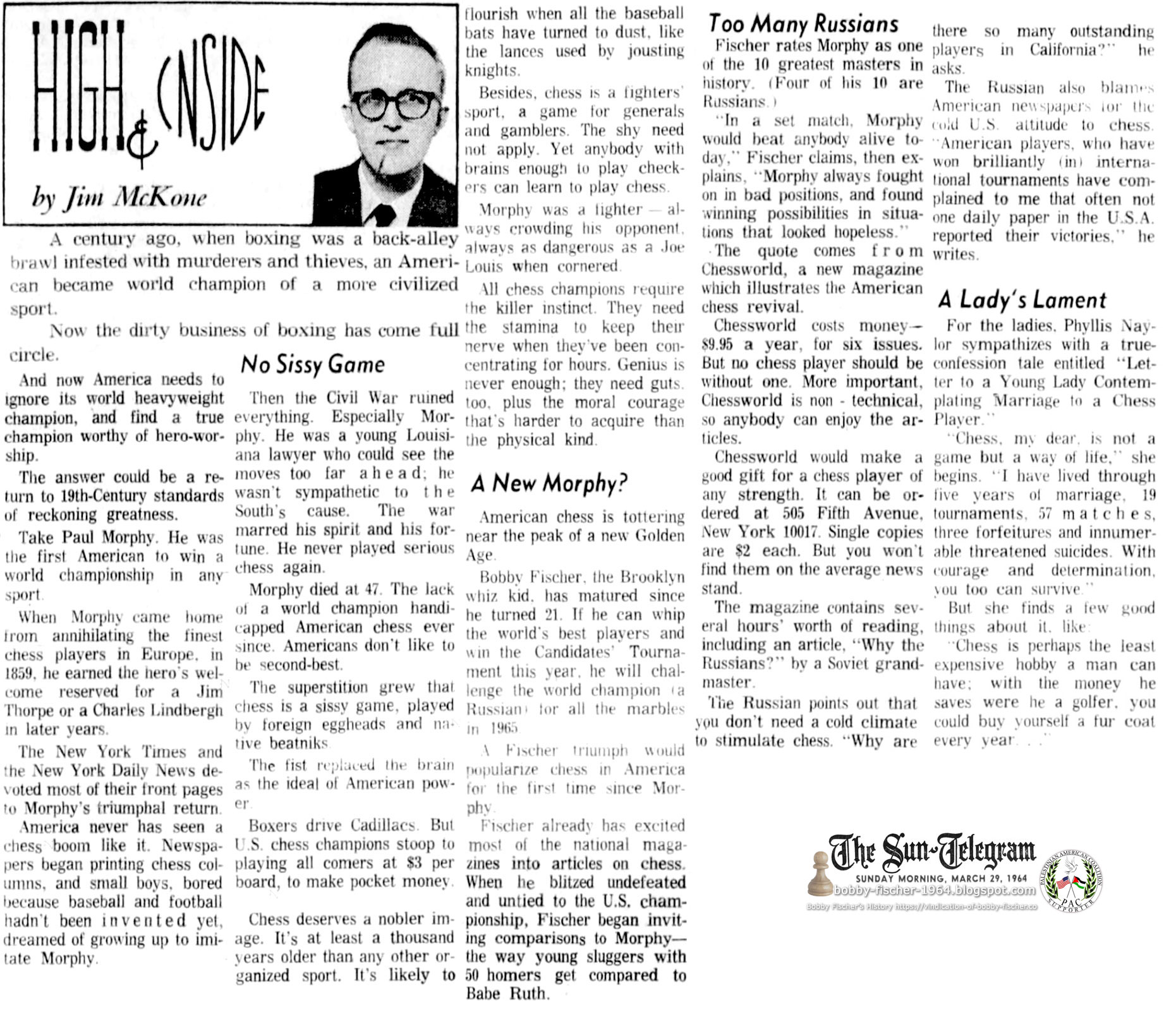
Paul Morphy, Bobby Fischer and Changing American Attitudes toward Chess

Back to 1964 News Articles

The San Bernardino County Sun San Bernardino, California Sunday, March 29, 1964 - Page 25

Chessworld: Paul Morphy, Bobby Fischer and Changing American Attitudes toward Chess

A century ago, when boxing was a back-alley brawl infested with murderers and thieves, an American became world champion of a more civilized sport.
Now the dirty business of boxing has come full circle.
And now America needs to ignore its world heavyweight champion, and find a true champion worthy of hero-worship.
The answer could be a return to 19th-Century standards of reckoning greatness. Take Paul Morphy. He was the first American to win a world championship in any sport.
When Morphy came home from annihilating the finest chess players in Europe, in 1859, he earned the hero's welcome reserved for a Jim Thorpe or a Charles Lindbergh in later years.
The New York Times and the New York Daily News devoted most of their front pages to Morphy's triumphal return.
America never has seen a chess boom like it. Newspapers began printing chess columns, and small boys, bored because baseball and football hadn't been invented yet, dreamed of growing up to imitate Morphy.

No Sissy Game
Then the Civil War ruined everything. Especially Morphy. He was a young Louisiana lawyer who could see the moves too far ahead; he wasn't sympathetic to the South's cause. The war marred his spirit and his fortune. He never played serious chess again.
Morphy died at 47. The lack of a world champion handicapped American chess ever since. Americans don't like to be second-best.
The superstition grew that chess is a sissy game, played by foreign eggheads and native beatniks.
The fist replaced the brain as the ideal of American power.
Boxers drive Cadillacs. But U.S. chess champions stoop to playing all corners at $3 per board, to make pocket money.

Chess deserves a nobler image. It's at least a thousand years older than any other organized sport. It's likely to flourish when all the baseball bats have turned to dust, like the lances used by jousting knights.
Besides, chess is a fighters' sport, a game for generals and gamblers. The shy need not apply. Yet anybody with brains enough to play checkers can learn to play chess.
Morphy was a fighter — always crowding his opponent, always as dangerous as a Joe Louis when cornered.
All chess champions require the killer instinct. They need the stamina to keep their nerve when they've been concentrating for hours. Genius is never enough; they need guts, too, plus the moral courage that's harder to acquire than the physical kind.

A New Morphy?
American chess is tottering near the peak of a new Golden Age.
Bobby Fischer, the Brooklyn whiz kid, has matured since he turned 21. If he can whip the world's best players and win the Candidates' Tournament this year, he will challenge the world champion (a Russian) for all the marbles in 1965.
A Fischer triumph would popularize chess in America for the first time since Morphy.
Fischer already has excited most of the national magazines into articles on chess. When he blitzed undefeated and untied to the U.S. championship, Fischer began inviting comparisons to Morphy—the way young sluggers with 50 homers get compared to Babe Ruth.

Too Many Russians
Fischer rates Morphy as one of the 10 greatest masters in history. (Four of his 10 are Russians).
“In a set match, Morphy would beat anybody alive today,” Fischer claims, then explains, “Morphy always fought on in bad positions, and found winning possibilities in situations that looked hopeless.”
The quote comes from Chessworld, a new magazine which illustrates the American chess revival.
Chessworld costs money—$9.95 a year, for six issues. But no chess player should be without one. More important. Chessworld is non-technical, so anybody can enjoy the articles.
Chessworld would make a good gift for a chess player of any strength. It can be ordered at 505 Fifth Avenue, New York 10017. Single copies are $2 each. But you won't find them on the average news stand.
The magazine contains several hours' worth of reading, including an article, “Why the Russians?” by a Soviet grandmaster.
The Russian points out that you don't need a cold climate to stimulate chess. “Why are there so many outstanding players in California?” he asks.
The Russian also blames American newspapers for the cold U.S attitude to chess. “American players, who have won brilliantly (in) international tournaments have complained to me that often not one daily paper in the U.S.A. reported their victories,” he writes.

A Lady's Lament
For the ladies. Phyllis Naylor sympathizes with a true-confession tale entitled “Letter to a Young Lady Contemplating Marriage to a Chess Player.”
“Chess, my dear, is not a game but a way of life,” she begins. “I have lived through five years of marriage, 19 tournaments, 57 matches, three forfeitures and innumerable threatened suicides. With courage and determination, you too can survive.”
But she finds a few good things about it, like:
“Chess is perhaps the least expensive hobby a man can have; with the money he saves were he a golfer, you could buy yourself a fur coat every year…”

Paul Morphy, Bobby Fischer and Changing American Attitudes toward Chess

Chessworld Review

Back to 1964 News Articles

The Los Angeles Times Los Angeles, California Sunday, March 22, 1964 - Page 84

CHESSWORLD
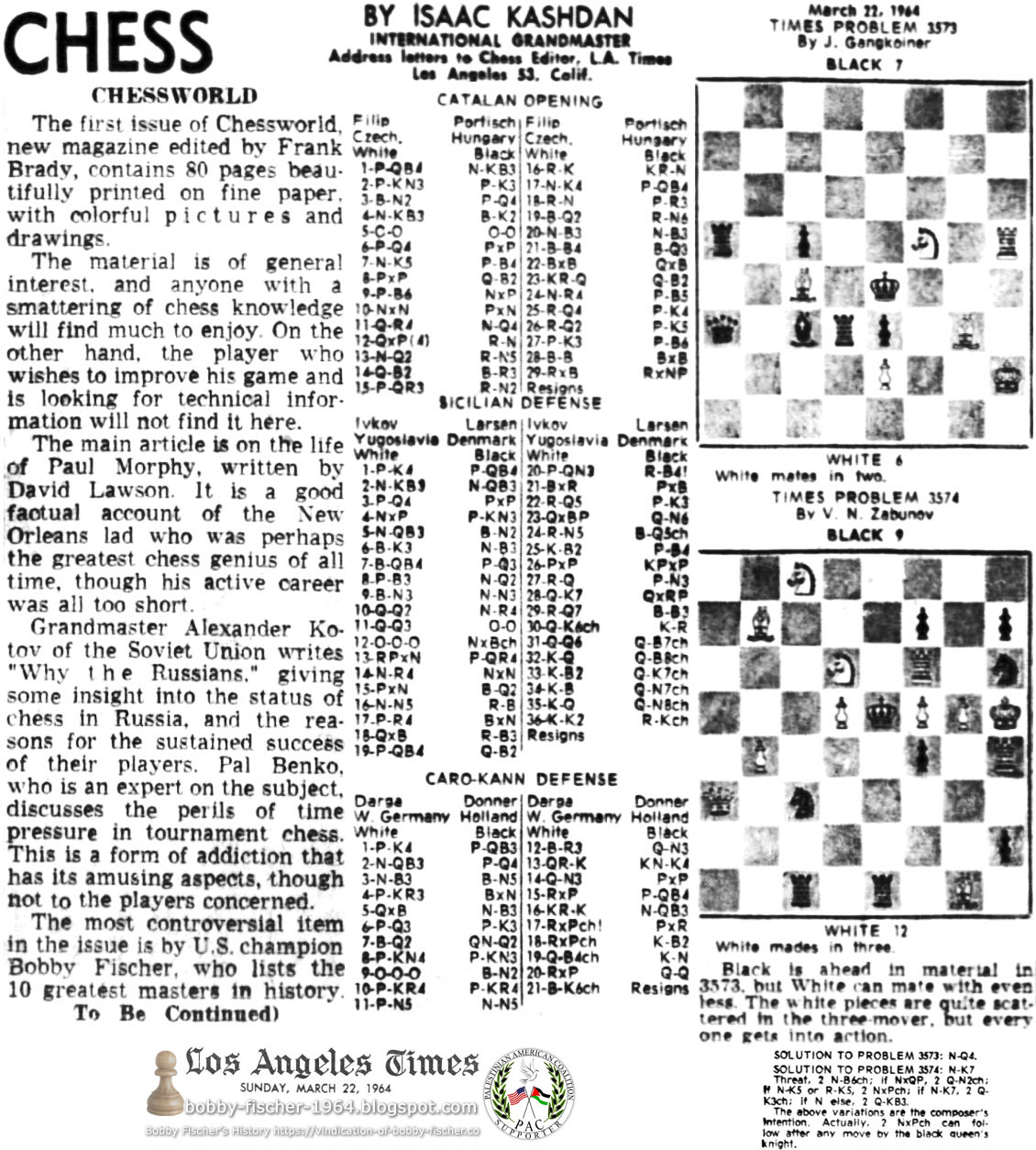
The first issue of Chessworld, new magazine edited by Frank Brady, contains 80 pages beautifully printed on fine paper with colorful pictures and drawings.
The material is of general interest, and anyone with a smattering of chess knowledge will find much to enjoy. On the other hand, the player who wishes to improve his game and is looking for technical information will not find it here.
The main article is on the life of Paul Morphy, written by David Lawson. It is a good factual account of the New Orleans lad who was perhaps the greatest chess genius of all time, though his active career was all too short.
Grandmaster Alexander Kotov of the Soviet Union writes “Why the Russians,” giving some insight into the status of chess in Russia, and the reasons for the sustained success of their players. Pal Benko, who is an expert on the subject, discusses the perils of time pressure in tournament chess. This is a form of addiction that has its amusing aspects, though not to the players concerned. The most controversial item in the issue is by U.S. champion Bobby Fischer, who lists the 10 greatest masters in history.
To Be Continued.

Chessworld Review

The Game of Kings

Back to 1964 News Articles

The Tribune Coshocton, Ohio Friday, January 17, 1964 - Page 4

The Game of Kings
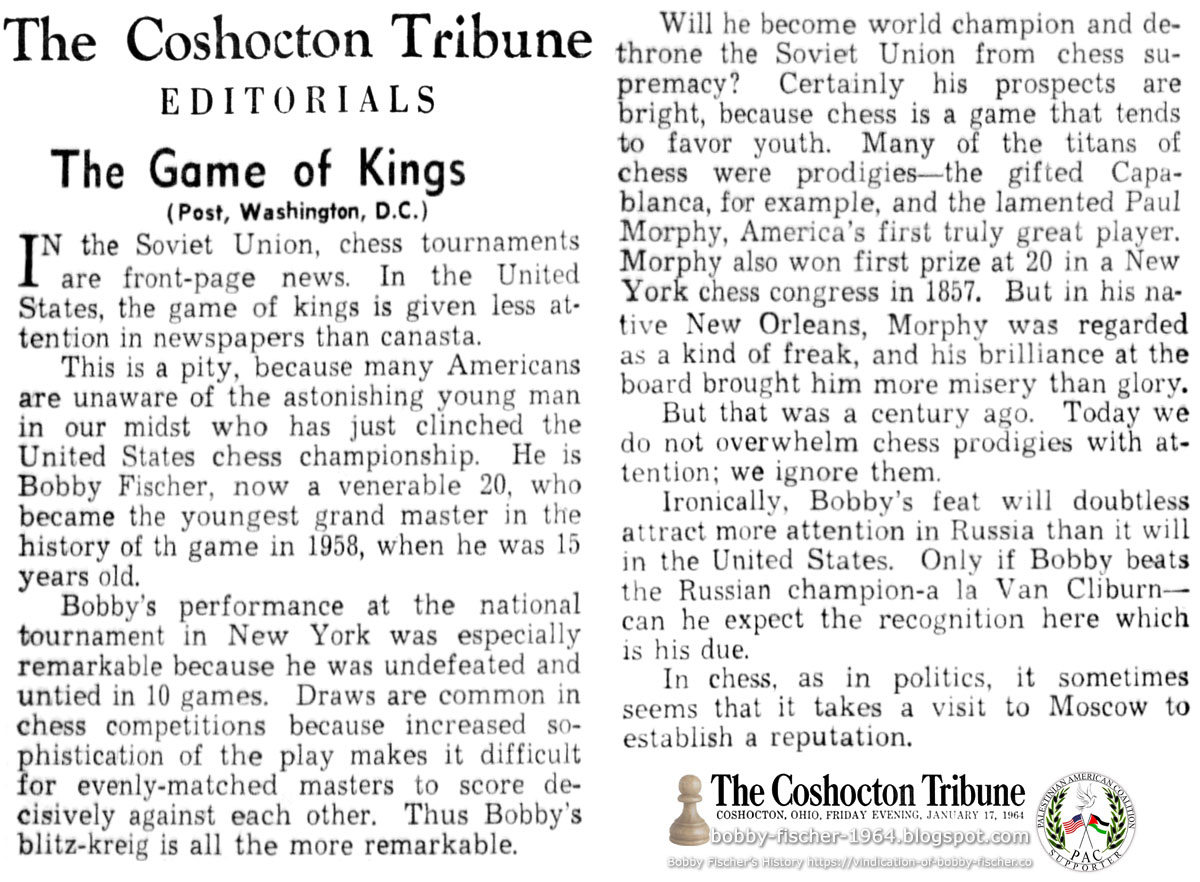
IN the Soviet Union, chess tournaments are front-page news. In the United States, the game of kings is given less attention in newspapers than canasta.
This is a pity, because many Americans are unaware of the astonishing young man in our midst who has just clinched the United States championship. His is Bobby Fischer, now a venerable 20, who became the youngest grand master in the history of the game in 1958, when he was 15 years old.
Bobby's performance at the national tournament in New York was especially remarkable because he was undefeated and untied in 10 games. Draws are common in chess competitions because increased sophistication of the play makes it difficult for evenly-matched masters to score decisively against each other. Thus Bobby's blitzkrieg is all the more remarkable.
Will he become world champion and dethrone the Soviet Union from chess supremacy? Certainly his prospects are bright, because chess is a game that tends to favor youth. Many of the titans of chess were prodigies—the gifted Capablanca, for example, and the lamented Paul Morphy, America's first truly great player. Morphy also won first prize at 20 in a New York chess congress in 1857. But in his native New Orleans, Morphy was regarded as a kind of freak, and his brilliance at the board brought him more misery than glory.
But that was a century ago. Today we do not overwhelm chess prodigies with attention; we ignore them.
Ironically, Bobby's feat will doubtless attract more attention in Russia than it will in the United States. Only if Bobby beats the Russian champion-a la Van Cliburn—can he expect the recognition here which is his due.
In chess, as in politics, it sometimes seems that it takes a visit to Moscow to establish a reputation.

The Game of Kings

Recommended Books

Understanding Chess by William Lombardy Chess Duels, My Games with the World Champions, by Yasser Seirawan No Regrets: Fischer-Spassky 1992, by Yasser Seirawan Chess Fundamentals, by Jose Capablanca Bobby Fischer Teaches Chess, by Bobby Fischer My 60 Memorable Games, by Bobby Fischer Bobby Fischer Games of Chess, by Bobby Fischer The Modern Chess Self Tutor, by David Bronstein Russians versus Fischer, by Mikhail Tal, Plisetsky, Taimanov, et al

'til the world understands why Robert J. Fischer criticised the U.S./British and Russian military industry imperial alliance and their own Israeli Apartheid. Sarah Wilkinson explains:

Bobby Fischer, First Amendment, Freedom of Speech
“What a sad story Fischer was,” typed a racist, pro-imperialist colonial troll who supports mega-corporation entities over human rights, police state policies & white supremacy.
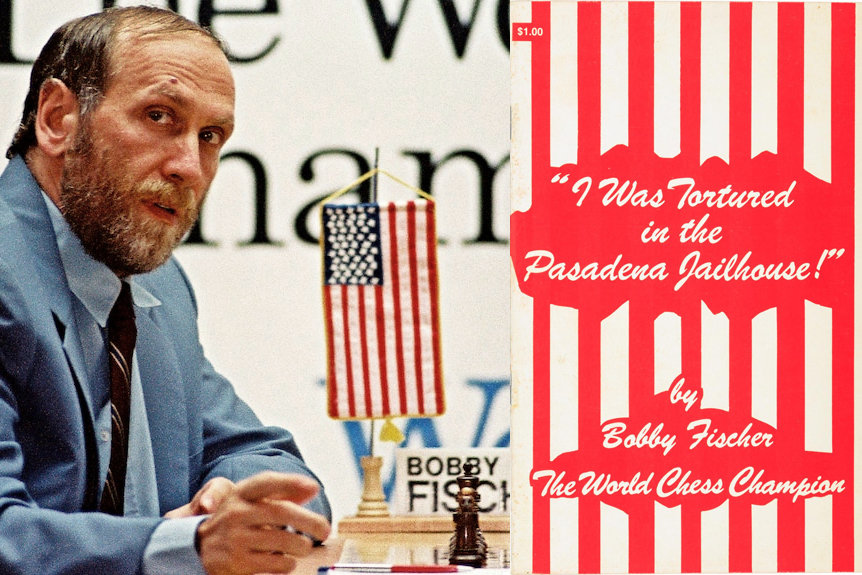
To which I replied: “Really? I think he [Bob Fischer] stood up to the broken system of corruption and raised awareness! Whether on the Palestinian/Israel-British-U.S. Imperial Apartheid scam, the Bush wars of ‘7 countries in 5 years,’ illegally, unconstitutionally which constituted mass xenocide or his run in with police brutality in Pasadena, California-- right here in the U.S., police run rampant over the Constitution of the U.S., on oath they swore to uphold, but when Americans don't know the law, and the cops either don't know or worse, “don't care” -- then I think that's pretty darn “sad”. I think Mr. Fischer held out and fought the good fight, steadfast til the day he died, and may he Rest In Peace.
Educate yourself about U.S./State Laws --
https://www.youtube.com/@AuditTheAudit/videos
After which the troll posted a string of profanities, confirming there was never any genuine sentiment of “compassion” for Mr. Fischer, rather an intent to inflict further defamatory remarks.

This ongoing work is a tribute to the life and accomplishments of Robert “Bobby” Fischer who passionately loved and studied chess history. May his life continue to inspire many other future generations of chess enthusiasts and kibitzers, alike.

Robert J. Fischer, Kid Chess Wizard 1956March 9, 1943 - January 17, 2008

The photograph of Bobby Fischer (above) from the March 02, 1956 The Tampa Times was discovered by Sharon Mooney (Bobby Fischer Newspaper Archive editor) on February 01, 2018 while gathering research materials for this ongoing newspaper archive project. Along with lost games now being translated into Algebraic notation and extractions from over two centuries of newspapers, it is but one of the many lost treasures to be found in the pages of old newspapers since our social media presence was first established November 11, 2017.

Special Thanks